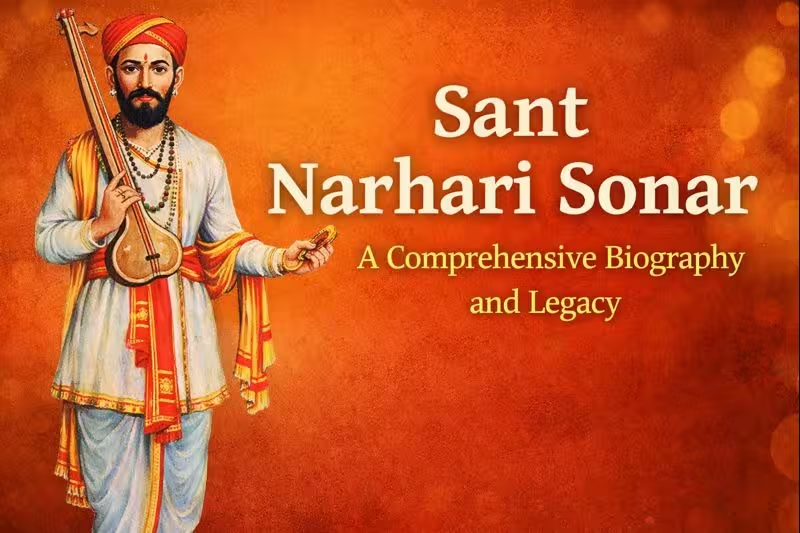
Sant Narhari Sonar is remembered in Maharashtra’s bhakti tradition as a saint who turned everyday work into worship and replaced sectarian pride with a lived experience of spiritual oneness. The word “Sonar” is not a title of royalty or an academic degree—it is a surname and community identity connected to the traditional profession of a goldsmith. Yet in Narhari’s life, that simple identity became a powerful spiritual metaphor: just as a goldsmith refines metal by heat, hammer, and patience, a seeker refines the mind through devotion, discipline, and surrender.
For readers who have never heard of him, Narhari Sonar offers something rare: a biography where faith is not described as an abstract philosophy, but as a transformation that happens in the middle of ordinary life—shopfront, tools, customers, and daily responsibilities. His story is also important because it sits at the heart of a long-standing cultural tension: the “Hari–Hara” debate, the rigid division some people create between Vishnu (Hari) and Shiva (Hara). Narhari’s life is celebrated as a bridge across that divide.
Who was Sant Narhari Sonar?
Sant Narhari Sonar was a poet-saint associated with Maharashtra’s Varkari bhakti movement and the devotional culture centered around Pandharpur. He is generally placed in the 13th–14th century in saint traditions, and his life is widely known through devotional biographies (charitras) and later hagiographies. While historical records for many medieval saints are limited, Narhari’s name lives strongly in the oral and literary traditions of Maharashtra through abhangs, kirtans, and community memory.
He is often described as someone who began with a firm sect identity and later discovered a deeper truth: the divine cannot be confined inside labels. This is why he is remembered not only as a devotee of Vithoba, but also as a saint who spoke about the oneness of God.
Why is he called “Sonar”?
“Sonar” literally means goldsmith. In many Marathi communities, it also functions as a surname that indicates a family’s traditional profession. Narhari’s identity as a goldsmith is not a side detail—it is central to how he is remembered.
In the bhakti tradition, saints often use the language of their lived world. A farmer speaks in images of soil and seed; a tailor speaks of cloth and stitches; a potter speaks of clay and the wheel. Narhari spoke as a goldsmith. In his devotional imagination, the workshop became a spiritual school: the furnace became the heat of tapas, the hammer became the discipline that shapes the soul, and pure gold became the refined inner self.
This is one reason his biography feels so relatable even today. He did not preach spirituality as an escape from daily life. Instead, he showed that the daily life itself can become the path.
When and where did Sant Narhari Sonar live?
Most devotional sources place Sant Narhari Sonar’s life in medieval Maharashtra, closely connected with Pandharpur, the pilgrimage center of Vithoba. Some traditions also link his earlier life to places connected with the Yadava-era region such as Devagiri (Daulatabad) before he settled in Pandharpur.
Because saint biographies were often preserved through oral narration and later written accounts, exact dates vary in different tellings. What remains consistent is the cultural setting: Maharashtra’s bhakti wave was flowering, the Varkari movement was shaping a collective devotional identity, and saints from many castes and professions were transforming spirituality into a people’s movement.
A Shaiva devotion in the town of Vithoba
Narhari’s early identity is commonly remembered as deeply Shaiva, centered on devotion to Lord Shiva. This detail is important because Pandharpur is primarily known as the town of Vithoba (Vitthal/Pandurang), a form of Vishnu worshipped by the Varkari tradition. In such a place, a proud, exclusive Shaiva devotion could easily turn into a kind of inner argument with the town itself.
Many retellings highlight that Narhari’s devotion was sincere but narrow—he loved Shiva deeply, yet he was unwilling to even look toward the temple of Vithoba. This is not described as hatred; it is described as a kind of spiritual stubbornness, the human tendency to defend our “one correct way” so strongly that we stop seeing the larger truth.
The turning point: the story of Vithoba’s waistband
The most famous episode in Sant Narhari Sonar’s biography is the story of the waistband (kamarband/waist ornament) made for Vithoba. In its most widely told form, the story begins with a devotee or wealthy patron who promises to offer a beautiful gold waistband to Vithoba, often as thanksgiving for a wish fulfilled.
The patron approaches Narhari Sonar because he is the finest goldsmith in town. Narhari agrees to craft the ornament, but he sets one condition: he will not enter the Vithoba temple. The patron must bring the measurements.
Narhari crafts the waistband with precision—yet when it is taken to the temple, it does not fit. In one attempt it feels too short; in another it becomes too long. Confused, the patron insists that Narhari himself must come and fit it properly. Narhari resists. He does not want to face the Vaishnava deity.
But the situation becomes impossible to ignore. In many tellings, Narhari finally goes—often blindfolded, so he can claim he is not “looking” at Vithoba. He reaches toward the stone image to measure the waist, and something unexpected happens. His hands touch features that remind him of Shiva: the feeling of a serpent-like belt, the impression of an animal-skin garment, and the mysterious sense that the deity before him is not “other.”
At that moment, Narhari’s inner wall breaks. Whether one reads this as a literal miracle, a symbolic experience, or a mystical insight, the message remains the same: Narhari realizes that the divine cannot be divided by ego and sect. The God he worshipped as Shiva and the God worshipped as Vithoba are not enemies standing across a boundary—they are expressions of the same ultimate reality.
This episode becomes the “biographical heart” of Narhari Sonar’s saintly identity. His transformation is not described as changing gods for social convenience. It is described as a realization.
What did Sant Narhari Sonar teach?
Sant Narhari Sonar is remembered for a simple but powerful spiritual direction: devotion must dissolve pride, not strengthen it. In many saint traditions, the most dangerous obstacle is not a lack of faith but the arrogance of thinking our faith makes us superior.
Narhari’s life story becomes a teaching in itself. It says that a person can be sincere, disciplined, even morally upright—yet still be trapped inside rigidity. His turning point teaches that true devotion expands the heart. It does not shrink it.
In the Varkari atmosphere, this naturally aligns with the emphasis on Nama-smaran (remembrance of God’s name), humility, service, and seeing God present everywhere.
When is Gajanan Maharaj Prakat Din 2025? Date, Significance & Celebrations
Sant Narhari Sonar’s abhangas and devotional poetry
Narhari Sonar is associated with abhangas, the Marathi devotional poems that became a lifeline of the Varkari tradition. Even when a reader does not know the full historical details of his life, his poetry preserves the tone of his inner world.
A unique feature of his abhangas is the way he uses goldsmith imagery. Instead of separating spirituality from work, he merges them. He speaks like someone who has watched raw metal become ornament through fire and effort, and he turns that experience into spiritual insight. In his devotional language, the “true ornament” is not jewelry worn on the body, but devotion that purifies the mind.
His poetry is also remembered for themes that appear again and again in Maharashtra’s saint tradition: the temporary nature of worldly pride, the need for a guru and guidance, the sweetness of God’s name, and the inner pull toward union with the divine.
What makes Narhari Sonar’s biography different from many other saints?
Many saint biographies are built around renunciation—leaving home, giving up wealth, retreating from society. Narhari Sonar’s biography is different. He remains connected to everyday life and the discipline of craft.
His sanctity is shown through integrity, humility, and transformation, not through dramatic withdrawal. His journey tells a common person: you do not have to become someone else to begin a spiritual life. You can begin where you are—at your workbench, your kitchen, your shop, your routine—if you bring sincerity and remembrance into it.
Sant Narhari Sonar and the Varkari tradition
Within Maharashtra’s larger saint lineage, Narhari Sonar is remembered among the saints who strengthened the social reach of the Varkari movement. One of the Varkari tradition’s most important historical contributions is that it created a shared devotional culture where saints came from many backgrounds—farmers, tailors, potters, Brahmins, artisans, and communities often ignored in elite religious narratives.
Narhari Sonar’s presence in this saint lineage symbolizes that devotion is not restricted to scholarship or social power. A goldsmith can become a spiritual teacher. A workshop can become a temple. A simple name can become a mantra.
Where is Sant Narhari Sonar remembered today?
Sant Narhari Sonar is closely associated with Pandharpur, and community memory preserves places linked to his life and devotion. The Sonar (goldsmith) community in particular holds him in deep respect, seeing him as both a spiritual ancestor and a saint whose life dignified their work.
His pुण्यतिथी (punyatithi) is commonly remembered in the month of Magh, and in many places devotees mark the day with bhajans, abhang-gayan, and remembrance of his teachings. Even when the exact historical date is debated in different tellings, the devotional calendar keeps his presence alive.
Are Shiva and Vithoba really “one” in Narhari’s message?
Narhari Sonar’s biography is often summarized as a saint’s answer to the Hari–Hara conflict. The deeper idea is not to erase differences of form and tradition, but to see that the ultimate divine reality is not divided. For many devotees, this becomes a practical teaching: worship that produces hatred is not worship; worship that produces humility and compassion is closer to truth.
What should a modern reader learn from Sant Narhari Sonar?
Sant Narhari Sonar’s life feels modern because it speaks to modern conflicts: identity wars, rigid labels, and the need to be “right” at the cost of being human. His story gently shows that the greatest spiritual achievement is not winning an argument but melting the ego.
He also offers an inspiring idea for working people: your profession is not separate from your spirituality. If your work is honest, disciplined, and offered with remembrance, it can become a path. This is why his famous identity—“Sonar”—remains meaningful. It is both a surname and a symbol.
In the end, Sant Narhari Sonar is remembered not only for what he made with gold, but for what he allowed God to make of him: a heart refined from pride into devotion, and from narrowness into oneness.