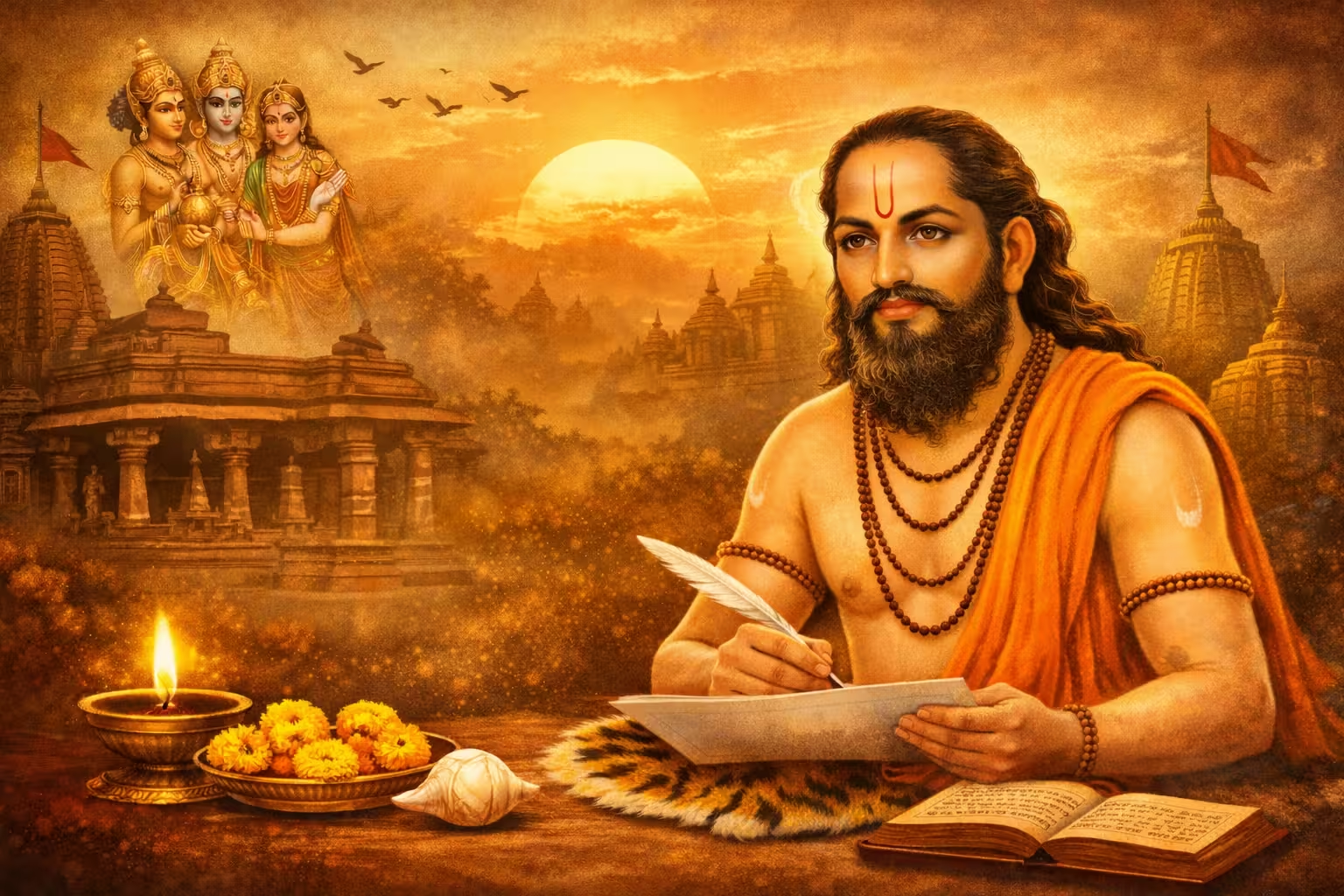
Shri Samarth Ramdas Swami was one of the most prominent spiritual leaders, philosophers, and poets of 17th-century India. In a period marked by political turmoil and social upheaval, he emerged not merely as a saint advocating silent devotion, but as a fierce proponent of physical strength, moral courage, and active resistance against injustice. Best known as the spiritual guide to the Maratha emperor Chhatrapati Shivaji Maharaj, Ramdas Swami uniquely blended the path of Bhakti (devotion) with Karma (action) and Shakti (strength). His teachings laid the spiritual and ideological foundation for a resurgent, independent society, making him a revered figure whose legacy continues to inspire millions today.
Early Life and the Call of Renunciation
Shri Ramdas Swami was born as Narayan Suryaji Thosar on the auspicious day of Ram Navami in 1608 CE (Chaitra Shukla Navami, Shake 1530). He was born in the village of Jamb in the Jalna district of Maharashtra to a pious couple, Suryajipant and Ranubai Thosar. From a very young age, Narayan exhibited an introverted and highly contemplative nature, often found meditating in solitude.
The turning point in his life occurred when he was just twelve years old. As was customary at the time, his family arranged his marriage. During the wedding ceremony, right before the final vows, the presiding priest chanted the traditional wedding verses ending with the word “Savadhan” (Beware/Be Alert). For the young Narayan, this word struck a deep spiritual chord. Interpreting it as a divine warning against getting entangled in worldly illusions (Maya), he abruptly fled the wedding altar, leaving behind his family and worldly life forever to seek spiritual truth.
Spiritual Journey and Unyielding Penance
After fleeing his wedding, Narayan traveled to the holy city of Panchavati in Nashik. He settled in a nearby village called Takli, where he undertook an incredibly rigorous period of penance (Tapasya) that lasted for twelve years.
Unlike many seekers who search for a human guru, Narayan considered Lord Rama to be his ultimate guide and supreme Guru. His daily routine at Takli was remarkably austere. He would stand in the knee-deep waters of the Godavari River from dawn until noon, repeatedly chanting the Gayatri Mantra and the thirteen-lettered Ram Taraka Mantra (Shri Ram Jai Ram Jai Jai Ram). It is believed that he chanted this mantra thirteen crore (130 million) times. Following his meditation, he would sustain himself solely on alms (Bhiksha) collected from the village.
Through this intense spiritual discipline, Narayan attained self-realization and a profound vision of Lord Rama. He subsequently adopted the name “Ramdas,” meaning “the servant of Rama,” and later earned the title “Samarth,” meaning “the omnipotent” or “the capable one,” reflecting his immense spiritual and intellectual prowess.
Teachings and Philosophy: The Synthesis of Prapancha and Paramartha
Shri Samarth Ramdas Swami’s philosophy was distinct from the purely ascetic traditions of his time. He recognized that a weak society could not defend its dharma (righteousness) or its people.
1. Balopasana (Worship of Strength): Ramdas Swami firmly believed that physical strength is a prerequisite for spiritual and national resurgence. He famously stated, “Bhakti (devotion) is incomplete without Shakti (strength).” He encouraged the youth to build robust bodies and established hundreds of temples dedicated to Lord Hanuman—the ultimate symbol of strength and devotion—across the country. These temples served as traditional gymnasiums (Akhadas) where young men were trained in wrestling and martial arts.
2. Balancing Worldly Duties and Spirituality: He taught the harmony of Prapancha (worldly duties) and Paramartha (spiritual pursuit). He advised householders not to abandon their families, but to perform their societal and familial duties with utmost perfection and detachment, dedicating the fruits of their actions to the Divine.
3. Pragmatism and Vigilance: His teachings are highly pragmatic. He emphasized continuous effort (Prayatna), alertness, leadership qualities, and the importance of reading and understanding human psychology. He urged people to be organized, united, and vigilant against political and cultural oppression.
Societal and Cultural Contributions
Ramdas Swami undertook an extensive pilgrimage across the Indian subcontinent for twelve years, deeply observing the socio-political degradation and the suffering of the masses. Realizing the need for a nationwide awakening, he established a widespread network of Mathas (monasteries) from the Himalayas to Kanyakumari.
These Mathas were not just centers of worship but dynamic hubs for social awakening, education, and the organization of youth. He created the Ramdasi Sampradaya (tradition), appointing dedicated disciples—both men and women—as heads of these centers to spread the message of dharma, self-respect, and national duty.
The Spiritual Guide to Chhatrapati Shivaji Maharaj
The association between Samarth Ramdas and Chhatrapati Shivaji Maharaj is one of the most celebrated spiritual-political alliances in Indian history. While Shivaji Maharaj was forging the Maratha Empire through martial brilliance, Ramdas Swami provided the moral, spiritual, and ideological backing necessary for Hindavi Swarajya (self-rule). Their relationship symbolizes the ideal ancient Indian concept of a philosopher-saint guiding a righteous king.
Notable Stories and Incidents
The Offering of the Kingdom: One of the most famous legends involves Shivaji Maharaj offering his entire kingdom to Ramdas Swami. Acknowledging the Maharaj’s devotion, Samarth Ramdas accepted the kingdom but immediately returned it, commanding Shivaji to rule it not as an owner, but as a humble trustee of the Divine. To symbolize this, Ramdas Swami gave Shivaji his ochre robe (Bhagwa Vastra), which was then hoisted as the Bhagwa Zhenda (the saffron flag)—the official standard of the Maratha Empire, representing sacrifice, purity, and asceticism.
The Miracle of the Sugarcane: Once, a proud scholar challenged Ramdas Swami’s spiritual authority. During the debate, Ramdas Swami simply touched a dry, lifeless piece of sugarcane, and it instantly began to sprout green leaves. This miracle humbled the scholar, demonstrating that true spiritual power lies beyond mere intellectual debate and resides in divine realization.
Immortal Literary Works
Samarth Ramdas was a prolific writer and poet, communicating complex Vedic philosophy in simple, everyday Marathi so that the common masses could understand it.
- Dasbodh: His magnum opus, written in the form of a dialogue between a Guru and a disciple. It is a comprehensive manual on life, covering everything from spiritual liberation to time management, leadership, and human psychology.
- Manache Shlok: A collection of 205 verses addressed directly to the mind. These melodious and simple verses are still recited daily in millions of Maharashtrian households to instill moral values and focus the wandering mind.
- Karunashtake: Deeply moving hymns of compassion and surrender addressed to the Divine.
- Aartis: He composed the universally beloved Aarti of Lord Ganesha, “Sukhakarta Dukhaharta,” as well as popular aartis for Lord Hanuman, Lord Rama, and other deities.
Places of Significance
Several holy sites are intimately connected to the life of Ramdas Swami and serve as pilgrimage centers today:
- Jamb Samarth (Jalna): His birthplace, which houses a beautiful temple dedicated to Lord Rama and Ramdas Swami.
- Panchavati and Takli (Nashik): The sacred site of his severe twelve-year penance and the location of the first Hanuman temple he established.
- Chaphal (Satara): The site where he established his first major Matha and built a grand temple for Lord Rama, initiating the public celebration of the Ram Navami festival.
- Sajjangad (Satara): Formerly known as Parali Fort, it was gifted to him by Shivaji Maharaj. It served as his final residence and is the site of his Samadhi (final resting place). Sajjangad remains the spiritual headquarters of the Ramdasi tradition.
Legacy and Remembrance
Shri Samarth Ramdas Swami took Sanjeevan Samadhi (consciously leaving the mortal body) in 1681 CE on the fort of Sajjangad.
Today, his legacy is vibrantly alive through the Ramdasi Sampradaya, a tradition that meticulously preserves his teachings, literature, and the disciplined lifestyle he advocated. His death anniversary is solemnly observed as Das Navami (the ninth day of the dark half of the month of Magha), which draws thousands of devotees to Sajjangad for days of uninterrupted chanting, reading of the Dasbodh, and spiritual discourses. Furthermore, his birth anniversary is celebrated alongside Ram Navami.
Through his timeless literature, the ubiquitous Hanuman temples, and his unyielding message of strength coupled with devotion, Shri Samarth Ramdas Swami continues to be a guiding light, teaching generations how to navigate the challenges of the world with a strong body, a pure mind, and an awakened soul.