Lord Ram, also known as Shri Rama, is one of the most widely worshipped deities in Hinduism. Revered as the seventh incarnation (avatar) of Lord Vishnu, he is the central figure of the great Hindu epic, the Ramayana. For millions of devotees, Lord Ram is not just a mythological king but the ultimate embodiment of truth, morality, and the ideal way of living. He is celebrated as Maryada Purushottam—the perfect man or the lord of self-control and virtue. His life story serves as a timeless guide on how to uphold Dharma (righteousness) in the face of immense adversity, making his legacy foundational to Hindu philosophy and culture.
Origin and Birth Story
The story of Lord Ram begins in the ancient city of Ayodhya, the capital of the Kosala Kingdom. The kingdom was ruled by the noble King Dasharatha, who had three wives—Kausalya, Kaikeyi, and Sumitra—but no heir to the throne. To seek the blessings of the gods for a child, King Dasharatha performed the Putrakameshti Yajna (a sacred fire ritual) under the guidance of Sage Rishyasringa.
Pleased with the ritual, Agni, the god of fire, emerged from the sacrificial kunda offering a bowl of divine dessert (payasam). King Dasharatha distributed this among his wives. As a result, Queen Kausalya gave birth to Ram, Queen Kaikeyi to Bharata, and Queen Sumitra to the twins Lakshmana and Shatrughna.
Lord Ram was born on the ninth day of the Hindu lunar month of Chaitra, a highly auspicious day that is globally celebrated by Hindus today as Ram Navami. From a young age, Ram displayed extraordinary valor, deep compassion, and a profound understanding of the scriptures, marking him as a divine child destined for greatness.
Significance, Roles, and Powers
Lord Ram’s primary role in the cosmic order was to restore Dharma (cosmic balance and righteousness) during a time when the world was tormented by the invincible demon king, Ravana. Unlike other avatars who displayed overt divine miracles, Ram’s power lay in his unwavering adherence to human limitations, ethics, and duties.
- Maryada Purushottam: Ram is the personification of strict adherence to rules and moral boundaries (maryada). He exemplifies the ideal son, the ideal brother, the ideal husband, the ideal friend, and the ideal king.
- Ram Rajya: His reign over Ayodhya is referred to as Ram Rajya, a utopian concept of governance characterized by absolute justice, peace, equality, and prosperity. It remains the ultimate benchmark for political and social administration in Indian thought.
- Destroyer of Evil: Though gentle by nature, Ram was a fiercely capable warrior. His power was not rooted in anger, but in the righteous necessity to protect the innocent and annihilate tyranny.
Symbolism: Appearance, Weapons, and Attributes
The iconography of Lord Ram is rich with spiritual symbolism, reflecting his divine nature and earthly mission.
Appearance
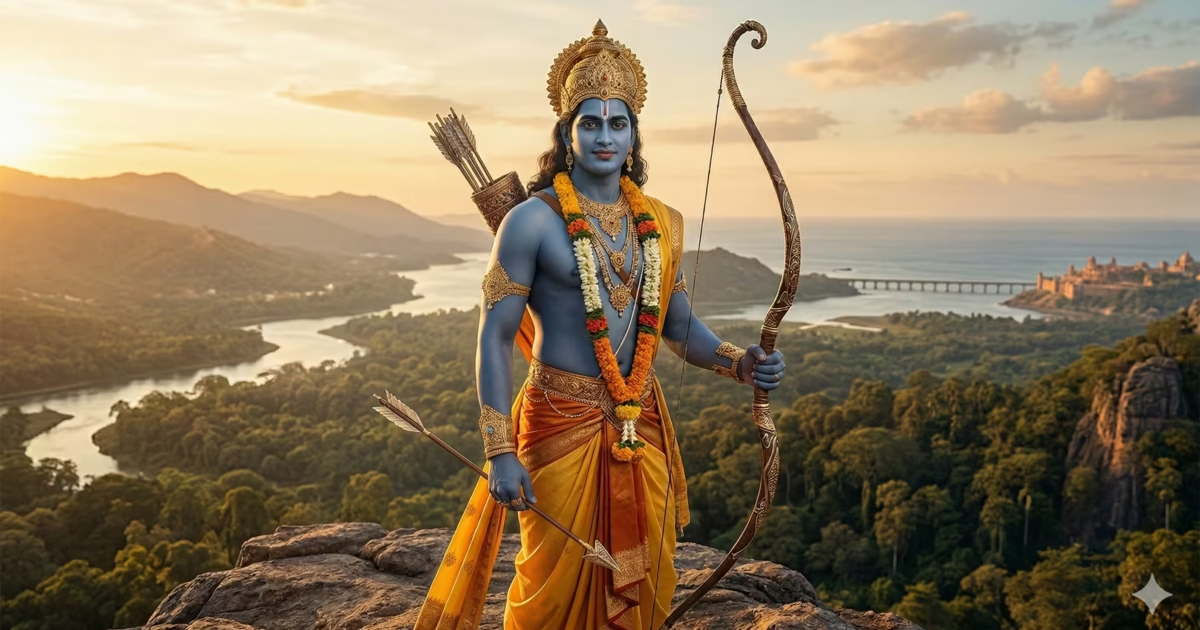
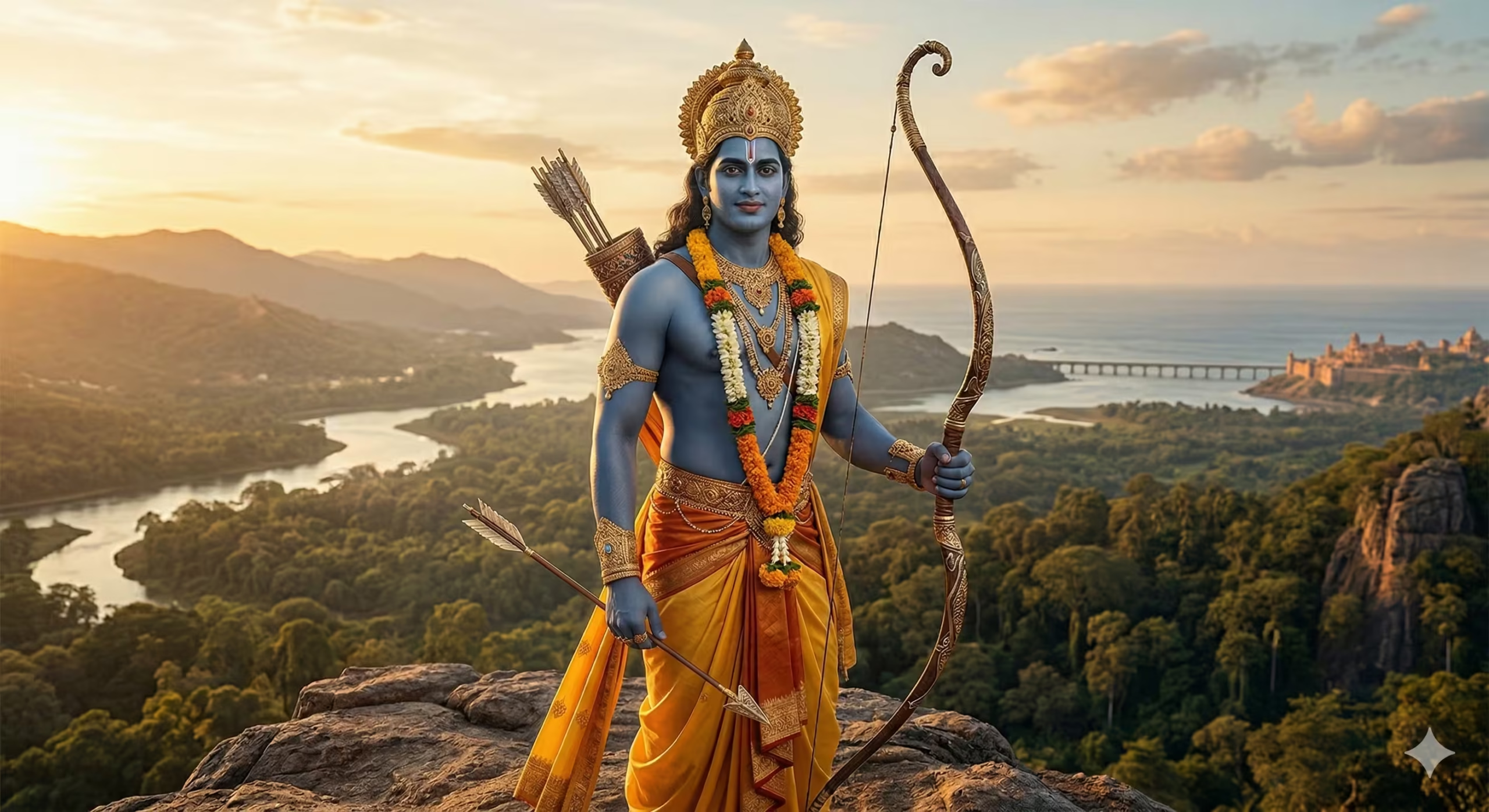
Lord Ram is typically depicted with a dark, bluish complexion (like a dark rain cloud). This blue skin represents his affinity with Lord Vishnu and symbolizes the infinite, akin to the boundless sky and the deep ocean. He is usually shown wearing yellow garments (Pitambara), symbolizing purity and auspiciousness, and adorned with princely jewelry, a floral garland, and a subtle, serene smile that indicates inner peace and supreme confidence.
Weapons and Symbols
- The Bow (Kodanda): Ram is almost always depicted holding a majestic bow in his left hand and an arrow in his right. The bow, known as Kodanda, symbolizes his readiness to defend the weak, uphold justice, and destroy evil.
- The Quiver: He carries a quiver of arrows on his back, representing infinite resources and the ultimate truth that his actions always hit their righteous mark.
Attributes
Ram is uniquely characterized by his calmness. Even in moments of extreme betrayal (like his sudden exile) or profound grief (like the abduction of his wife), he maintains his composure, illustrating the spiritual ideal of emotional equilibrium (Sthitaprajna).
Important Stories and Legends
The life of Lord Ram is chronicled primarily in Valmiki’s Ramayana and Tulsidas’s Ramcharitmanas. His journey is marked by several defining events:
The Swayamvar of Sita
Ram accompanied Sage Vishwamitra to the kingdom of Mithila, ruled by King Janaka. To win the hand of King Janaka’s daughter, Sita, a suitor had to lift and string the massive bow of Lord Shiva (Pinaka). Many mighty kings failed, but Ram not only lifted it with ease but broke it while stringing it, thus winning Sita as his eternal consort.
The Fourteen-Year Exile (Vanavas)
On the eve of Ram’s coronation as the king of Ayodhya, his stepmother Kaikeyi, influenced by her maid Manthara, invoked two boons promised to her by King Dasharatha. She demanded that her son Bharata be crowned king and that Ram be exiled to the forest for fourteen years. To honor his father’s word, Ram accepted the exile without a moment’s hesitation. His devoted wife Sita and loyal brother Lakshmana insisted on accompanying him.
The Abduction of Sita
While living in the Dandaka forest, the demon king Ravana of Lanka used deceit to abduct Sita. He sent a magical golden deer to distract Ram and Lakshmana, allowing him to kidnap Sita and carry her off to his island kingdom.
The Search and the Alliance
Ram’s grief-stricken search for Sita led him to Kishkindha, the kingdom of the Vanaras (monkey race). Here, he met his greatest devotee, Hanuman, and forged an alliance with the Vanara king, Sugriva. Hanuman leaped across the ocean, discovered Sita in Lanka, and brought back news to Ram.
The Epic War and Return to Ayodhya
With the help of the Vanara army, Ram built a bridge (Ram Setu) across the ocean to Lanka. A colossal war ensued, culminating in Ram defeating and killing Ravana, symbolizing the ultimate triumph of good over evil. After completing his fourteen-year exile, Ram returned to Ayodhya with Sita and Lakshmana. The citizens of Ayodhya welcomed them by lighting thousands of oil lamps, an event that gave birth to the festival of Diwali.
Avatars, Forms, and Associated Deities
Lord Ram does not exist in isolation in Hindu theology; he is part of a divine collective that represents different facets of the supreme reality.
- Lord Vishnu: Ram is the seventh manifestation of the preserver god, Vishnu, descending to earth to restore cosmic order.
- Goddess Sita: The eternal consort of Ram, Sita is an avatar of Goddess Lakshmi. She embodies devotion, purity, and the resilience of the earth (having been born from the earth itself).
- Lakshmana, Bharata, and Shatrughna: Ram’s brothers are also divine incarnations. Lakshmana is the avatar of Shesha Naga (the cosmic serpent on whom Vishnu rests), Bharata represents the Sudarshana Chakra (Vishnu’s divine weapon), and Shatrughna embodies the Panchajanya (Vishnu’s conch).
- Lord Hanuman: The supreme devotee of Lord Ram, Hanuman is an avatar of Lord Shiva (Rudra) and the wind god (Vayu). He represents selfless service, strength, and unwavering devotion (Bhakti).
- Luv and Kush: The twin sons of Ram and Sita, who grew up in Sage Valmiki’s ashram and later became the heirs to the Kosala Kingdom, propagating the story of the Ramayana.
Major Temples
The worship of Lord Ram is deeply entrenched in the geography of the Indian subcontinent. Several highly revered shrines are dedicated to him:
- Ram Janmabhoomi Temple, Ayodhya (Uttar Pradesh): The most sacred site for Ram devotees, believed to be the exact birthplace of Lord Ram.
- Ramanathaswamy Temple, Rameswaram (Tamil Nadu): A major pilgrimage site where Lord Ram is said to have worshipped Lord Shiva to absolve the sin of killing Ravana (a Brahmin). It is one of the Char Dham pilgrimage destinations.
- Sita Ramachandraswamy Temple, Bhadrachalam (Telangana): Often referred to as the “Ayodhya of the South,” this temple on the banks of the Godavari River is famous for its intricate architecture and spiritual significance.
- Kalaram Temple, Nashik (Maharashtra): Situated in the Panchavati area where Ram, Sita, and Lakshmana spent a significant portion of their exile, this temple houses a unique black stone idol of Lord Ram.
Festivals and Worship Practices
The adoration of Lord Ram permeates daily Hindu life, reaching its peak during several major annual festivals.
- Ram Navami: Celebrated in the spring month of Chaitra, this festival marks the birth of Lord Ram. Devotees observe fasts, sing devotional songs (bhajans), and perform special pujas.
- Diwali (Deepavali): The festival of lights commemorates the return of Lord Ram, Sita, and Lakshmana to Ayodhya after 14 years of exile and the defeat of Ravana. Houses are decorated with earthen lamps (diyas) to symbolize the victory of light over darkness.
- Dussehra (Vijayadashami): This festival falls immediately after Navaratri and celebrates Ram’s victory over the demon king Ravana. Effigies of Ravana, his brother Kumbhakarna, and son Meghanada are burnt to signify the destruction of evil.
- Reading the Epics: A common worship practice is the continuous recitation (Akhand Paath) of the Ramcharitmanas by Tulsidas or Valmiki’s Ramayana.
- Chanting the Taraka Mantra: The simple chanting of the name “Ram” (known as the Taraka Mantra) is considered one of the most powerful spiritual practices in Hinduism, believed to liberate the soul from the cycle of birth and death.