In the vast and intricate pantheon of Hinduism, the cosmos is governed by the Trimurti (the Hindu Trinity), which represents the three fundamental forces of the universe: creation, preservation, and destruction. At the helm of creation is Lord Brahma, the architect of the cosmos and all living beings.
While he is one of the most prominent deities in Hindu scriptures, Lord Brahma occupies a unique and somewhat paradoxical position. Despite his supreme role as the creator, he has very few temples dedicated to him. To truly understand Hindu cosmology, one must explore the origins, symbolism, and profound legends associated with Lord Brahma.
Origin and Birth Story of Lord Brahma
The origins of Lord Brahma are described in various Hindu scriptures, primarily the Puranas and the Upanishads, which offer deeply philosophical and symbolic accounts of his birth.
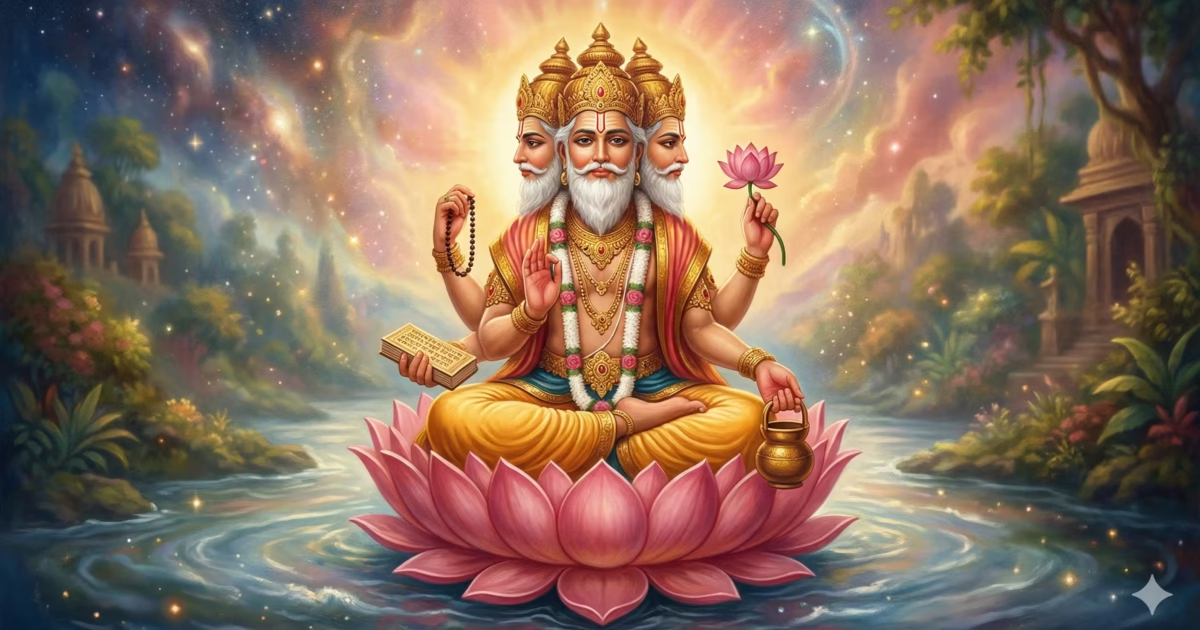
- The Lotus Origin (Padmaja): According to Vaishnava Puranas, before the creation of the universe, Lord Vishnu was resting on the great serpent Ananta Shesha in the cosmic ocean (Kshira Sagara). From Vishnu’s navel, a magnificent lotus flower emerged. Seated at the center of this blooming lotus was Lord Brahma. Due to this origin, he is often referred to as Padmaja (the lotus-born) or Nabhija (born from the navel).
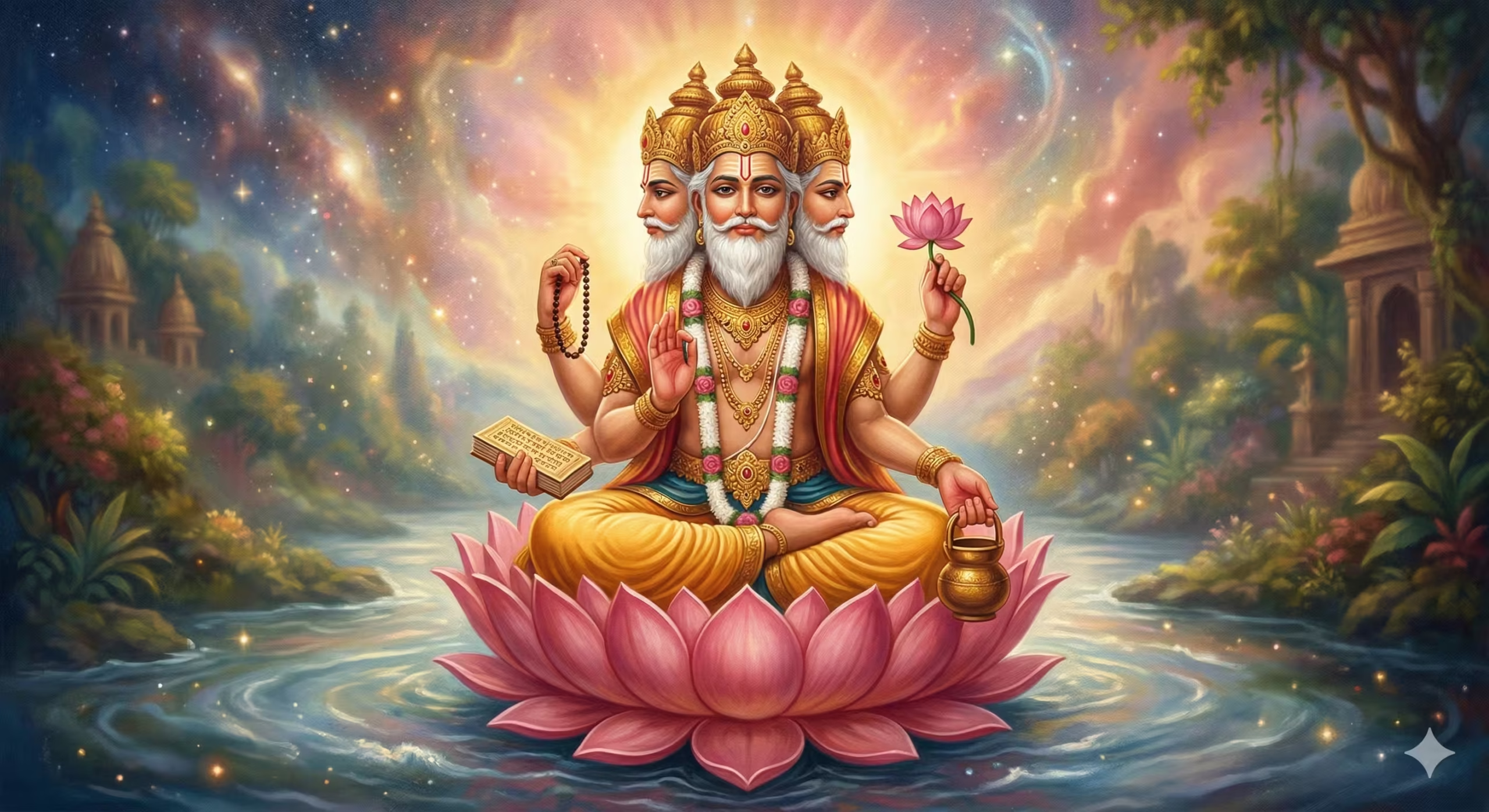
- The Golden Egg (Hiranyagarbha): The Vedas and Manu Smriti offer a different perspective. They state that the supreme, unmanifested reality placed a seed in the cosmic waters. This seed turned into a brilliant golden egg known as Hiranyagarbha. After residing in this egg for a divine year, Brahma expanded it into two halves, creating the heavens and the earth, effectively birthing himself as Swayambhu (the self-born).
Significance in Hinduism
Lord Brahma’s primary significance lies in his role as the initiator of the cycle of life. If Lord Vishnu is the preserver who maintains cosmic order, and Lord Shiva is the destroyer who paves the way for renewal, Lord Brahma is the visionary who brings form to the unmanifested. He represents the physical universe, intellect, and the creative power of the mind. Furthermore, he is revered as the ultimate source of all spiritual and secular knowledge.
Roles and Powers
As the creator, Lord Brahma possesses distinct roles and immense cosmic powers that govern the functioning of the universe:
- Creation of Life and Matter: Brahma is responsible for crafting all forms of life, from the highest celestial beings to the smallest insects, as well as the physical matter of the universe.
- Source of the Vedas: He is considered the author and revealer of the four Vedas (Rigveda, Yajurveda, Samaveda, and Atharvaveda), which contain the supreme knowledge of the universe.
- Keeper of Cosmic Time: In Hindu cosmology, time is cyclical, and its scale is intimately tied to Lord Brahma. A single day in the life of Brahma is called a Kalpa, which equals 4.32 billion human years. During his day, the universe exists, and during his night, it is absorbed back into a state of rest (partial dissolution). His full lifespan is said to be 100 “Brahma years,” after which the entire universe is dissolved (Maha Pralaya), and a new Brahma is born.
Symbolism and Iconography
Hindu deities are highly symbolic, and every aspect of Lord Brahma’s appearance carries profound philosophical meaning. He is traditionally depicted as an elderly man with a red or golden complexion, symbolizing his eternal wisdom and the fiery energy of creation.
The Four Heads
Lord Brahma originally had five heads, but is now universally depicted with four. These four heads represent:
- The four Vedas (Rig, Yajur, Sama, Atharva).
- The four Yugas (epochs) of cosmic time.
- The four Varnas (social orders).
- The four cardinal directions, signifying that his creative vision encompasses the entire universe.
The Four Arms and Weapons
Unlike other major deities, Brahma does not carry weapons of war. His four arms represent the four aspects of human personality: the mind (Manas), the intellect (Buddhi), the ego (Ahamkara), and the conditioned consciousness (Chitta). In his hands, he holds:
- The Vedas: Symbolizing knowledge and intellect as the foundation of creation.
- A Japa Mala (Rosary): Made of Rudraksha beads, representing the spiritual dimension of time, focus, and meditation.
- A Kamandalu (Water Pot): Containing the cosmic water, ether, or the primeval soup from which all creation springs.
- A Lotus Flower: Representing nature, living reality, and the supreme truth unfolding.
The Vehicle (Vahana): The Hamsa
Lord Brahma’s mount is the Hamsa, a divine swan or goose. In Hindu symbolism, the swan represents grace and discernment. It is believed that a mythical swan possesses Neer-Ksheer Viveka—the ability to separate pure milk from a mixture of milk and water. This signifies that the creator, and by extension humanity, must possess the wisdom to distinguish between good and evil, truth and illusion.
Important Stories and Legends
The mythology surrounding Lord Brahma is rich with tales that explain his nature, his relationship with other gods, and his unique status in modern worship.
Why is Lord Brahma Rarely Worshipped?
Despite being the creator, Lord Brahma is notably absent from widespread domestic worship. Two primary legends explain this phenomenon:
- The Curse of Lord Shiva: According to the Shiva Purana, Brahma and Vishnu once argued over who was supreme. Suddenly, a towering, infinite pillar of fire (the Jyotirlinga) appeared between them. They agreed that whoever found the end of the pillar would be declared supreme. Vishnu took the form of a boar and dug downward, while Brahma took the form of a swan and flew upward. Neither could find the end. Vishnu honestly admitted defeat, but Brahma found a Ketaki flower falling from the top and convinced it to falsely testify that he had reached the summit. Enraged by this lie, Lord Shiva emerged from the pillar, cut off Brahma’s fifth head (which had uttered the lie), and cursed him that he would never be widely worshipped by humanity.
- The Curse of Goddess Saraswati: In another legend, Lord Brahma was preparing to conduct a grand Yagna (fire sacrifice) at Pushkar. The presence of his wife, Goddess Saraswati, was mandatory for the rituals. When she was delayed, an impatient Brahma married a local milkmaid, Gayatri, to complete the ceremony on time. Upon arriving and seeing another woman taking her rightful place, a furious Saraswati cursed Brahma, decreeing that he would only ever be worshipped in Pushkar.
Associated Deities, Consorts, and Progeny
Lord Brahma’s creative process involves various divine entities who assist in manifesting and populating the universe.
Goddess Saraswati (The Consort)
Goddess Saraswati is the divine consort of Lord Brahma. She is the goddess of wisdom, learning, music, and the arts. Her association with Brahma is deeply symbolic: to create the universe, Brahma requires intelligence and knowledge. Saraswati provides the divine wisdom necessary to execute the complex task of creation.
The Mind-Born Sons (Manas Putras)
Unlike Vishnu or Shiva, Brahma does not traditionally have earthly “avatars” or incarnations. Instead, he manifests his creative will through his progeny. By the sheer power of his mind, he created the Manas Putras (mind-born sons).
- The Prajapatis: These are the patriarchs or the “lords of creatures” (including figures like Daksha, Bhrigu, and Marichi) tasked with populating the cosmos with gods, demons, humans, and animals.
- The Four Kumaras: Sanaka, Sanandana, Sanatana, and Sanatkumara were created to assist in creation, but they refused to procreate, choosing instead a path of lifelong celibacy and spiritual devotion.
- Narada Muni: The divine sage and messenger of the gods, known for his devotion to Lord Vishnu, was also born from the mind of Lord Brahma.
Temples, Festivals, and Worship Practices
Because of the mythological curses, dedicated temples to Lord Brahma are exceedingly rare, especially when compared to the thousands of shrines dedicated to Shiva, Vishnu, and various Goddesses.
Major Temples
- Brahma Temple, Pushkar (Rajasthan): This is the most famous and prominent Brahma temple in the world. Situated near the sacred Pushkar Lake, it dates back to the 14th century and remains the primary center of Brahma worship globally.
- Asotra Brahma Temple (Rajasthan): Located in the Barmer district, this is another significant temple built in the 20th century.
- Thirunavaya Navamukunda Temple (Kerala): While primarily a Vishnu temple, it holds significant importance for the rites performed for ancestors, where Lord Brahma, Vishnu, and Shiva are jointly honored.
- Carambolim Brahma Temple (Goa): An ancient shrine housing an exquisite, intricately carved stone idol of Lord Brahma dating back to the Kadamba period.
- Kumbakonam Brahma Temple (Tamil Nadu): Here, he is worshipped alongside Lord Vishnu and Lord Shiva, signifying his ongoing relevance in the holy triad.
Festivals and Worship
The most significant time for worshipping Lord Brahma is during Kartik Poornima, the full moon night in the Hindu month of Kartik (usually October/November). During this time, the world-famous Pushkar Fair takes place. Millions of pilgrims gather to take a holy dip in Pushkar Lake, which is believed to have been formed by a lotus dropped by Lord Brahma, and offer special prayers at his temple.
While everyday devotion to him is rare, Lord Brahma is intrinsically invoked during almost all major Hindu rituals. During Yagnas (fire sacrifices) and Kumbhabhishekams (temple consecrations), a space is always reserved for Brahma, and specific Vedic chants are recited to seek his blessings for a successful outcome. He remains a foundational, respected, and indispensable pillar of Hindu theology and ritual practice.