Goddess Ekvira, affectionately revered as Ekvira Aai (Mother Ekvira), is a highly venerated Hindu deity, particularly in the western Indian state of Maharashtra. Widely recognized as an incarnation of Goddess Renuka—the mother of Lord Parashurama (the sixth avatar of Lord Vishnu)—Ekvira Devi occupies a central place in Maharashtrian folk and Vedic traditions.
She is predominantly worshipped as the Kuldaivat (family deity) by several indigenous and historical communities, most notably the Koli (fisherfolk), Agri, and Chandraseniya Kayastha Prabhu (CKP) communities. For her devotees, Ekvira Devi is not just a mythological figure but a living, breathing mother who fiercely protects her children, blesses them with prosperity, and guides them safely through the turbulent waters of life.
The Origin and Birth Story of Ekvira Devi
The origin of Ekvira Devi is intrinsically linked to the ancient Puranic legends of Goddess Renuka and Sage Jamadagni. According to Hindu mythology, Renuka was the devoted wife of the great sage Jamadagni and the mother of five sons, the youngest being Lord Parashurama.
Renuka possessed immense spiritual power derived from her unwavering chastity and devotion to her husband, which allowed her to fetch water from the river in unbaked clay pots. However, one day, while observing a celestial being (Gandharva), she experienced a momentary lapse in her focus. Losing her spiritual power, the unbaked pot dissolved in the river. Enraged by this slight deviation, the quick-tempered Sage Jamadagni ordered his sons to behead their mother. While the elder sons refused, Parashurama, bound by filial duty, obeyed and severed her head.
Pleased with Parashurama’s obedience, Jamadagni granted him a boon. Parashurama immediately asked for his mother’s life to be restored. Through divine intervention and the sage’s powers, Renuka was resurrected. In regional folklore, it is believed that during this resurrection, Goddess Renuka manifested in various divine forms across India to bless her devotees. Ekvira Devi is celebrated as one of these potent and primary manifestations of Goddess Renuka, embodying her eternal motherly love and fierce protective energy.
Significance, Roles, and Powers
Ekvira Devi holds immense sociological and spiritual significance. Her roles and powers are multifaceted, catering to the diverse needs of the communities that worship her:
- Protector of the Seas: For the Koli community, whose livelihoods depend entirely on the unpredictable Arabian Sea, Ekvira Devi is the ultimate protector. She is believed to calm the storms, ensure a bountiful catch, and guide the fishermen safely back to the shores.
- Bestower of Fertility and Prosperity: Ekvira Devi is revered as a symbol of cosmic fertility. Newlyweds and childless couples frequently visit her shrines to seek blessings for healthy progeny and domestic harmony.
- Remover of Obstacles: Known for her fierce yet compassionate nature, devotees pray to Ekvira Aai to ward off evil eyes, cure illnesses, and remove insurmountable obstacles from their personal and professional lives.
Symbolism: Appearance, Weapons, and Attributes
The iconography of Ekvira Devi is rich in symbolism, reflecting her dual nature as a nurturing mother and a fierce warrior against evil.
- Appearance: In her primary sanctums, she is often represented by a radiant, self-manifested (Swayambhu) stone mask or mukhavata adorned with a prominent nose ring (nath), expressive eyes, and bright vermilion (sindoor) and turmeric (haldi). When depicted in full form, she is shown as a beautiful, commanding goddess draped in a traditional Maharashtrian Navvari (nine-yard) saree.
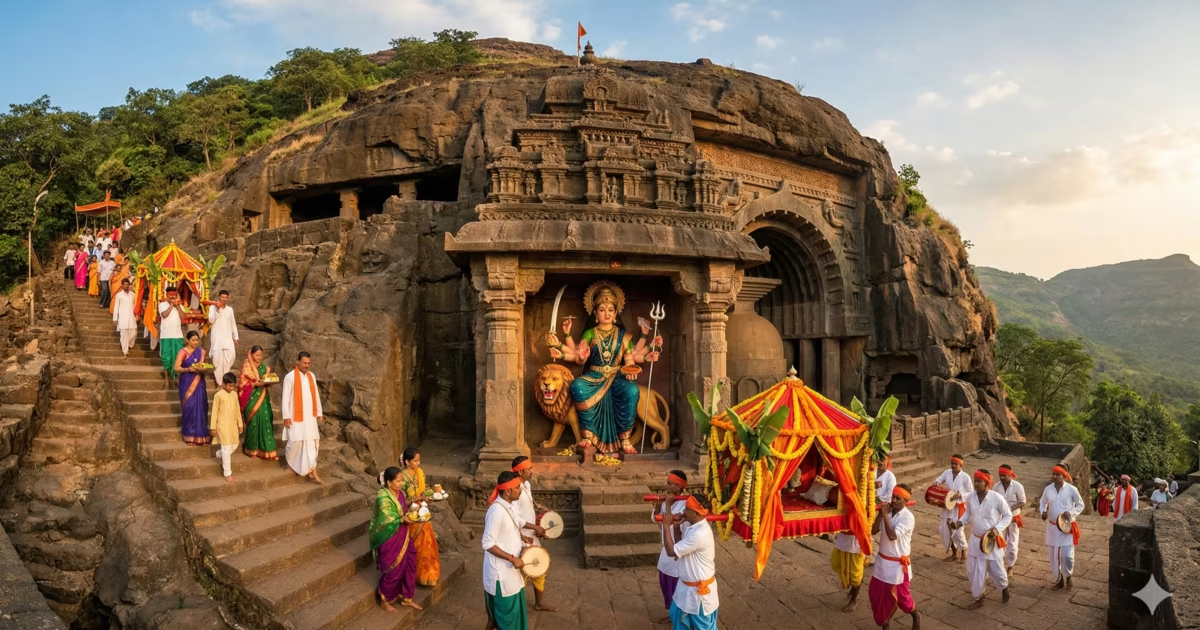
- Weapons: She is typically visualized with four arms (Chaturbhuja). She holds a sword (Khadga) representing the severance of ego and ignorance, a trident (Trishul) symbolizing control over the three realms (physical, mental, and spiritual), a drum (Damaru) signifying the cosmic sound of creation, and a bowl or lotus representing nourishment and purity.
- Vehicle (Vahana): Ekvira Devi rides a lion, which symbolizes raw power, courage, and sovereignty. The lion represents her mastery over animalistic instincts and her readiness to fiercely defend dharma (righteousness).
Legends and Stories Associated with Ekvira Devi
The Pandavas and the Karla Caves
The most famous legend associated with Ekvira Devi intertwines with the epic Mahabharata. During their harsh Vanavasa (forest exile), the five Pandava brothers, along with their wife Draupadi, wandered into the dense forests of the Sahyadri mountains. Seeking a safe haven, they prayed to Goddess Ekvira.
Pleased with their devotion, the Goddess appeared before them. She instructed the Pandavas to carve a magnificent shrine out of the rocky mountainside, but laid down a divine condition: the entire temple complex had to be built overnight, before the break of dawn. Empowered by the Goddess’s blessings, the Pandavas worked with superhuman speed and carved the breathtaking Karla Caves. In return for their monumental effort, Ekvira Devi granted them a boon of protection, ensuring that their true identities would remain entirely concealed during their impending Agyatavasa (the final year of living incognito).
Associated Deities and Forms
Ekvira Devi does not exist in theological isolation. She is part of a broader network of deities and divine forms, structured hierarchically in regional worship:
1. Goddess Renuka (The Supreme Form)
Ekvira is fundamentally an avatar of Renuka. While Ekvira is the localized, accessible form worshipped in Maharashtra, Renuka is the universal mother figure in the broader Puranic text. The Mahur temple in Maharashtra is dedicated directly to Renuka Mata.
2. Lord Parashurama (The Divine Son)
As the son of Renuka, Parashurama is intrinsically linked to Ekvira Devi. In many folk traditions, honoring the mother also involves invoking the blessings of her warrior-sage son, who is revered for ridding the earth of tyrannical rulers.
3. Goddess Yellamma (The Southern Counterpart)
In the neighboring states of Karnataka, Telangana, and Andhra Pradesh, the same divine energy of Renuka is worshipped as Goddess Yellamma. The mythologies of Ekvira and Yellamma share striking parallels, both representing the rural, earthy manifestations of the divine feminine.
4. Lord Shiva / Bhairava (The Guardian)
In traditional Maharashtrian goddess worship, the divine mother is often accompanied by a fierce guardian deity. Lord Shiva, often in his localized forms like Jyotiba or Khandoba, is worshipped as a protector of the Goddess’s realm.
Major Temples, Festivals, and Worship Practices
The Karla Caves Temple
The spiritual epicenter of Ekvira Devi worship is her ancient temple located just outside the Karla Caves near Lonavala, Maharashtra. Situated high on a hill, devotees must climb hundreds of steep steps to reach the main shrine. The temple uniquely stands right next to a massive, ancient Buddhist Chaitya (prayer hall), showcasing a beautiful syncretism of India’s historical religious traditions.
Festivals and Celebrations
The atmosphere around the Ekvira Devi temple becomes highly electrifying during her major festivals:
- Chaitra Navratri (Spring Navratri): This is the grandest festival for Ekvira Devi. Millions of devotees converge at the Lonavala temple. The Koli community arrives in large, colorful processions.
- Ashwin Navratri (Autumn Navratri): The traditional nine nights of Goddess worship are celebrated with elaborate rituals, Ghatasthapana (installation of the sacred pot), and continuous chanting.
Worship Practices and Rituals
The worship of Ekvira Aai is characterized by deep emotional fervor and traditional folk practices.
- The Koli Dance: Fisherfolk dress in their traditional, vibrant attire and perform the energetic Koli dance to the beats of the dhol (drums) as an offering of joy to the Mother Goddess.
- Palkhi (Palanquin) Processions: Devotees carry beautifully decorated palanquins housing the Goddess’s symbolic representations from their coastal villages all the way up the hill to the Karla temple.
- Offerings: Traditional offerings include Puran Poli (a sweet flatbread), coconuts, flower garlands (especially jasmine and marigold), and turmeric. In certain localized folk traditions practiced outside the main Vedic sanctum, symbolic sacrifices or specific regional delicacies are also offered to appease her fierce aspect.