Raksha Bandhan is one of the most heartwarming, deeply spiritual, and eagerly awaited festivals in India, intricately woven into the country’s vast cultural framework. Emerging during the lush, rain-washed month of Shravana, the festival brings with it a wave of nostalgia, joy, and familial warmth. At its core, Raksha Bandhan—often simply called Rakhi—is a grand celebration of the pure, unconditional love, mutual respect, and lifelong bond shared between brothers and sisters.
While it is celebrated primarily by Hindus, the spirit of the festival transcends religious boundaries and is joyously embraced by people of various faiths across the Indian subcontinent and the global diaspora. Furthermore, the festival beautifully goes beyond biological ties to honor cousins, close friends, neighbors, and any protective figures who step into the role of a guardian.
The emotional significance of Raksha Bandhan is profound and transformative. The word “Raksha” translates directly to “protection,” while “Bandhan” means “bond” or “tie.” Therefore, it is the “Tie of Protection.” When a sister ties the sacred thread around her brother’s wrist, she is not merely performing a ritual; she is offering a powerful prayer for his health, spiritual prosperity, longevity, and overall well-being. In return, the brother offers thoughtful gifts and takes a solemn, lifelong vow to protect, respect, and support her through all of life’s adversities, acting as her shield against the world’s hardships.
Raksha Bandhan 2026 Date and Time
Every year, the festival is observed on the auspicious full moon day (Purnima) of the Hindu lunisolar month of Shravana. This month is highly revered in Hindu philosophy, associated with Lord Shiva, the life-giving monsoon rains, and spiritual renewal. For those planning their family gatherings, travel itineraries, and festive preparations, knowing the exact Raksha Bandhan 2026 date and time is crucial for performing the sacred rituals correctly according to strict Vedic traditions.
- Raksha Bandhan 2026 Date: 28 August 2026 (Friday)
- Tithi: Shravan Purnima
- Purnima Tithi Begins: 09:08 AM on 27 August 2026
- Purnima Tithi Ends: 09:48 AM on 28 August 2026
The Purnima (full moon) brings a surge of positive cosmic energy, making it the perfect backdrop for ceremonies that bind human souls together in love and duty.
Rakhi 2026 Muhurat and Shubh Samay
In Hindu tradition, the timing of a ceremony is just as important as the devotion with which it is performed. Tying the Rakhi during an auspicious window (Muhurat) ensures that the rituals are aligned with the favorable positioning of the stars and planets, thereby maximizing the flow of positive cosmic energy and divine blessings.
The Rakhi 2026 muhurat—the most auspicious and spiritually charged time to tie the thread—spans the crisp morning hours of 28 August. Families should aim to complete the main Puja Vidhi within this window:
- Shubh Muhurat for Rakhi Tying: 05:57 AM to 09:48 AM (Friday, 28 August 2026)
- Total Duration: Approximately 3 Hours 51 Minutes
Bhadra Kaal Raksha Bandhan 2026
In Vedic astrology, Bhadra Kaal is considered a highly inauspicious and turbulent period for performing sacred, auspicious ceremonies—particularly Raksha Bandhan and Holika Dahan. According to ancient scriptures, Bhadra is a destructive entity, the sister of Lord Shani (Saturn), and tying a Rakhi during her active period is believed to bring misfortune, conflict, and obstacles into the brother's life.
Fortunately, families can breathe a sigh of relief regarding the Bhadra kaal Raksha Bandhan 2026 timing, as it will not disrupt the main daytime festivities. In 2026, the restrictive Bhadra period officially ends before sunrise on 28 August. This means that households can joyously celebrate, prepare their thalis, and perform the Rakhi tying ceremony freely during the morning Shubh Muhurat without any astrological hindrance or fear of negative cosmic interference.
History and Origin of Raksha Bandhan
The roots of Raksha Bandhan trace back thousands of years to ancient Hindu mythology, Puranic literature, and grand historical epics. The festival is not based on a single event but rather a tapestry of legends that highlight the origin of this beautiful tradition of protection:
- Krishna and Draupadi: One of the most famous legends occurs during the epic Mahabharata. Lord Krishna accidentally cut his finger while wielding his divine weapon, the Sudarshan Chakra. Seeing her beloved friend and guide bleed, Draupadi, the wife of the Pandavas, immediately tore a piece of silk cloth from her own royal saree and tied it around his bleeding finger. Touched by her spontaneous affection and sacrifice, Krishna promised to protect her forever. He fulfilled this vow dramatically during her Cheer Haran (the disrobing incident in the Kaurava court) by extending her saree infinitely, protecting her dignity when all others failed her.
- King Bali and Goddess Lakshmi: According to the Bhagavata Purana, after Lord Vishnu conquered the three worlds from the demon king Bali, Bali asked Vishnu to live in his palace. Vishnu agreed, leaving his abode in Vaikuntha. Goddess Lakshmi, longing for her husband’s return, visited Bali disguised as a mortal woman seeking refuge. On Shravana Purnima, she tied a sacred cotton thread to King Bali’s wrist. Touched, Bali granted her a boon. Lakshmi revealed her true form and asked for her husband’s return. True to his word, Bali released Lord Vishnu, cementing the Rakhi as a bond of supreme honor and promise.
- Yama and Yamuna: It is believed that the God of Death, Yama, did not visit his sister Yamuna for twelve long years. Upon the gentle advice of Goddess Ganga, Yama finally visited Yamuna. Overjoyed, she welcomed him with grand hospitality, prepared a massive feast, and tied a sacred thread on his wrist. Deeply moved by her love, Yama declared that any brother who wears a Rakhi tied by his sister and promises to protect her will be granted a long life and attain immortality.
- Indra and Sachi: Highlighting that Rakhi was originally a general talisman of protection rather than just a sibling bond, the Bhavishya Purana tells the story of Lord Indra losing a fierce battle against the powerful demon King Bali. His wife, Queen Sachi (Indrani), consulted Lord Vishnu in despair. She was given a spiritually charged, sacred cotton thread, which she tied around Indra’s right wrist. This talisman empowered him to defeat the demons and regain his celestial kingdom.
Significance and Importance of Rakhi Festival
The importance of Rakhi festival transcends the simple, materialistic act of gifting. Spiritually and psychologically, it acts as an emotional anchor that reinforces familial duties, mutual respect, and lifelong loyalty.
In today’s hyper-connected yet often isolated, fast-paced world, Raksha Bandhan serves as a crucial, designated time for families to pause, reunite, put aside petty grievances, and cherish their shared childhood memories. It is a time of forgiveness and emotional renewal. The Rakhi is not just a decorative, colorful thread; it is a Raksha Sutra (a protective armor) woven meticulously with a sister’s prayers, positive affirmations, and divine blessings. It acts as a psychological shield, giving the brother the confidence that he is loved and supported, while assuring the sister that she is never truly alone in the world.
Raksha Bandhan Rituals Step by Step (Puja Vidhi)
To attract peace, prosperity, and the boundless blessings of the deities, it is essential to perform the ceremony with a pure heart and follow the traditional Raksha Bandhan rituals step by step. Every element used in the puja holds deep symbolic meaning.
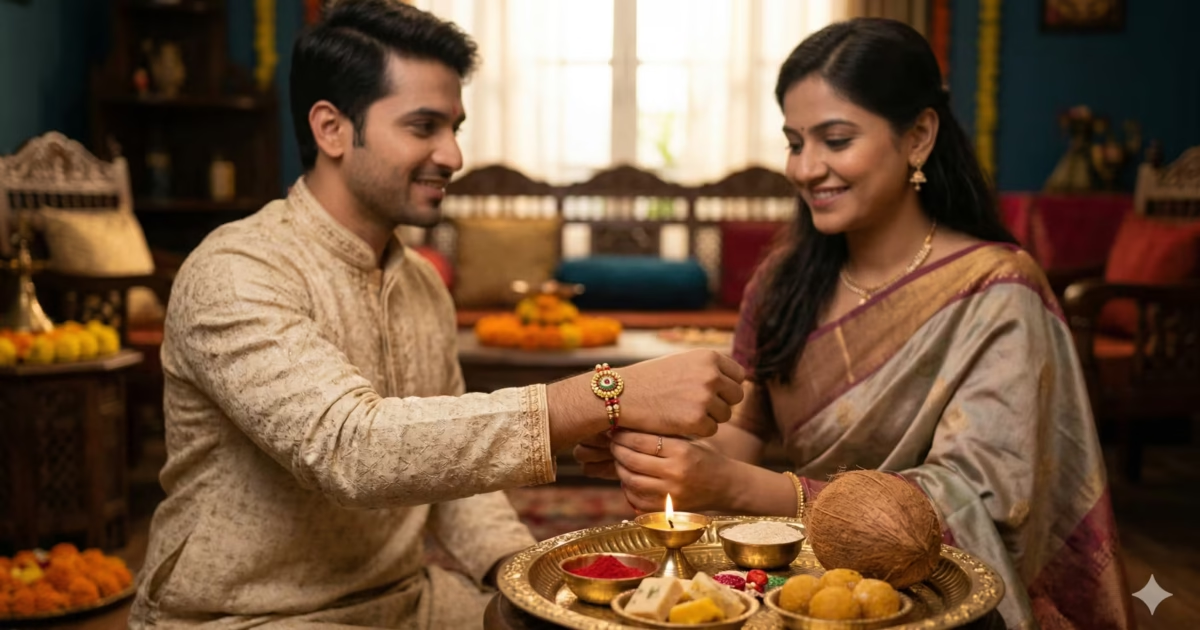
- Preparation of the Puja Thali: Begin by meticulously arranging a beautiful, often silver or brass, Rakhi thali. It should contain:
- Rakhi: The sacred thread symbolizing the bond.
- Roli (red kumkum powder): Represents energy, strength, and the Goddess Lakshmi.
- Akshat (unbroken rice grains): Symbolizes wealth, prosperity, and a life free of obstacles (broken rice is considered inauspicious).
- Diya (oil or ghee lamp): Represents the fire deity, Agni, acting as a witness to the vow and bringing the light of wisdom.
- Sweets and Coconut: Symbolize happiness, the sweetness of the relationship, and auspicious beginnings.
- Invocation of Deities: Before tying the Rakhi to your brother, it is a highly auspicious practice to first offer a Rakhi to Lord Ganesha, Lord Krishna, or your family deity (Ishta Devta) to seek divine protection and grace for your entire household.
- Seating Arrangement: Ask your brother to sit comfortably on a clean mat (asana), facing either the East (the direction of the rising sun and enlightenment) or the North (the direction of wealth). He should cover his head with a handkerchief or a clean cloth as a profound mark of respect for the divine energies present during the puja.
- Applying the Tilak: The sister lovingly applies a tilak of Roli and Akshat on the center of the brother’s forehead. This specific spot is the Ajna Chakra (the third eye). The tilak symbolizes the awakening of inner wisdom, patience, spiritual sight, and the suppression of ego.
- Performing the Aarti: The sister then performs aarti by rotating the lit diya in a slow, clockwise direction in front of her brother’s face. This purifying act is believed to ward off evil eyes (Buri Nazar), banish negative energies, and cast a protective aura around him.
- Tying the Rakhi: With heartfelt prayers for his success and health, the sister ties the Rakhi around her brother’s right wrist. Traditionally, a sacred mantra is chanted during this step: “Yena baddho Bali raja, Danavendro mahabalah, Tena twam anubadhnaami, Rakshe maa chala maa chala” (I tie you with the same protective thread that bound the powerful demon king Bali. O thread, do not falter, do not falter).
- Sweetening the Bond: After the thread is securely tied, the sister feeds her brother a piece of traditional Indian sweet (like barfi, laddu, ghewar, or kaju katli), and he reciprocates by feeding her, symbolizing the sweetening of their lifelong relationship.
- Exchange of Gifts and Blessings: Finally, the brother presents his sister with Rakhi gifts as a tangible token of his love and commitment. If the brother is younger, he touches his sister’s feet to seek her blessings; if older, the sister touches his feet in reverence.
Meaning of Rakhi and the Sacred Brother-Sister Bond
The Rakhi thread itself is a profound metaphor. Though physically fragile, it represents an unbreakable emotional and spiritual commitment. The bond between a brother and sister is unique—it is a blend of childhood rivalry, deep-seated friendship, fierce protectiveness, and unconditional love. The Rakhi serves as a lifelong reminder of this sacred dynamic, bridging geographical distances and emotional gaps. It represents the promise that no matter where life takes them, siblings will always be each other’s primary support system.
Traditions and Customs Followed in Different Regions of India
India is a land of incredible diversity, and while the core sentiment of love and protection remains the exact same, Raksha Bandhan is celebrated with diverse, colorful regional flavors across the subcontinent:
- Western India (Maharashtra, Goa, and Coastal Gujarat): Celebrated uniquely as Narali Purnima (Coconut Day). The coastal and fishing communities offer coconuts to Lord Varuna (the God of the Sea) by throwing them into the ocean. This gesture seeks his blessings to calm the monsoon waters and ensure a safe, bountiful fishing season. Siblings also eat sweet coconut rice on this day.
- Eastern India (West Bengal and Odisha): In these regions, the day coincides with Jhulan Purnima, an enchanting festival celebrating the eternal romance of Lord Krishna and Radha. Elaborate idols of the deities are placed on beautifully decorated swings (jhoolas) adorned with monsoon flowers. Sisters tie Rakhis to their brothers amidst these joyous festivities.
- Northern India (Punjab, Haryana, Uttar Pradesh): Here, it is primarily a massive sibling festival involving grand, multi-generational family feasts. In addition to the Rakhi tying, the day is marked by vibrant kite-flying competitions, where brothers engage in friendly aerial battles, and sisters cheer them on while sharing traditional sweets like Ghewar.
- Southern India (Tamil Nadu, Kerala, Andhra Pradesh): Known as Avani Avittam or Upakarma, this day is particularly vital for the Brahmin and scholarly communities. It is a day of spiritual cleansing where men discard their old sacred thread (Janeyu), take a holy dip in water bodies, and don a new thread, taking solemn vows to perform their karmic and Vedic duties with pure, renewed intentions.
- Central India (Madhya Pradesh and Chhattisgarh): Celebrated as Kajari Purnima, this variation is crucial for farmers and women. Women collect soil in leafy cups, sow barley or wheat, and pray to Goddess Bhagavati for a rich, healthy crop harvest, asking for the protection of their agricultural livelihood alongside the protection of their brothers.
How Raksha Bandhan is Celebrated Today
Modern Raksha Bandhan celebrations are a fascinating, beautiful blend of deeply rooted ancient traditions and fast-paced contemporary lifestyles. Weeks before the festival, bustling local markets and online stores are flooded with vibrant Rakhis. These range from traditional, simple Mauli threads and sandalwood beads to modern designer bracelets, silver bands, and even eco-friendly “plantable” Rakhis embedded with flower seeds that can be grown into plants after the festival.
On the day of the festival, families gather in their finest attire for grand lunches featuring an array of traditional Indian delicacies. However, the modern world has redefined proximity. In cases where siblings live in different cities, states, or even countries, digital celebrations have seamlessly bridged the gap. Sisters send online Rakhis through international couriers, and siblings connect over video calls across different time zones to perform the rituals virtually. A sister might do the aarti in front of a webcam, ensuring that physical distance does not diminish the festive spirit or the emotional resonance of the day.
The exchange of gifts has also evolved significantly. While traditional cash envelopes (Shagun) are still popular, modern brothers are increasingly opting for personalized gifts, the latest gadgets, self-care and grooming kits, sponsored vacations, or even financial investments like mutual funds or health insurance policies to secure their sister’s future in a highly practical way.
What to Do on Raksha Bandhan (Dos)
- Observe a Fast Before the Ritual: Sisters traditionally observe a mild fast (abstaining from solid food) from the morning until the Rakhi is successfully tied. This purifies the body and mind, showing the sincerity of her prayers.
- Wear Clean, Festive Clothes: It is customary to take an early morning bath to cleanse the physical body and wear fresh, bright-colored traditional Indian attire (like kurtas, sarees, or lehengas) to welcome the festive energy.
- Verify Timings Diligently: Always use a trusted Hindu Panchang (calendar) to verify the auspicious tying window, ensuring you do not perform the sacred ritual during Rahu Kaal or Bhadra Kaal.
- Include Sisters and Sister-in-laws: Today, it is beautifully common and encouraged for sisters to tie Rakhis to each other, celebrating female solidarity. Furthermore, in communities like Marwaris, sisters tie a special Lumba Rakhi to their sister-in-law’s bangle, acknowledging her role in protecting the family’s honor and unity.
What to Avoid on Raksha Bandhan (Don’ts)
- Never Tie Rakhi During Bhadra: As emphatically established by astrologers, tying a Rakhi during the Bhadra Kaal is strictly prohibited in Hindu scriptures, as it invites negative energy and discord.
- Avoid Broken Rice on the Thali: When preparing the Puja Thali, meticulously pick out whole grains of rice. Ensure the Akshat is unbroken, as fragmented rice is considered incomplete and inauspicious for invoking blessings.
- Avoid Wearing Dark, Somber Colors: Try to avoid wearing entirely black or very dark attire during the Puja. Bright, vibrant colors like red, yellow, pink, and orange are highly favored for drawing in positive, joyous energy.
- Don’t Leave the Head Uncovered: Out of respect for the divine presence invoked during the religious Aarti and Tilak, both the brother and the sister should ideally have their heads covered with a dupatta, scarf, or handkerchief.
Cultural, Emotional, and Social Importance of the Festival
Raksha Bandhan is a phenomenon that goes far beyond a single-day celebration; it is a vital pillar of Indian societal values. Culturally, it acts as a unifying thread that weaves together the incredibly diverse, multi-lingual, and multi-religious fabric of Indian society.
Historically, the festival has been used as an instrument of peace and diplomacy. Queens have famously sent Rakhis to neighboring kings—even those of entirely different faiths—to forge powerful alliances and halt wars. The most legendary example is when Rani Karnavati of the besieged kingdom of Chittor sent a Rakhi to the Mughal Emperor Humayun, calling upon him as a brother to protect her kingdom from invasion. Even during the Indian Independence movement, Nobel Laureate Rabindranath Tagore brilliantly utilized the concept of Raksha Bandhan in 1905 to unite Hindus and Muslims during the painful partition of Bengal, urging them to tie Rakhis on each other’s wrists as a vow to protect one another against British divide-and-rule policies.
Emotionally, the festival nurtures crucial human qualities such as empathy, responsibility, sacrifice, and mutual respect within the microcosm of the family unit. It teaches young boys the importance of respecting and protecting women, and it teaches young girls the value of spiritual support and love.
Socially, Raksha Bandhan promotes the broader, more magnificent idea of universal brotherhood and global harmony. In schools, community centers, and neighborhoods, it is common to see children tying Rakhis to their classmates, local police officers, security guards, and soldiers stationed at the borders. This profound act acknowledges the protection, safety, and care they receive from society at large, effectively turning an entire nation into a large, protective family. Ultimately, Raksha Bandhan stands tall as a timeless, brilliant testament to the enduring power of love, the nobility of duty, and the invisible, sacred threads that hold humanity together through the ages.