Do you know why Lord Vishnu, the preserver of the universe, had to take the form of an ordinary black stone known as ‘Shaligram’? And why, even today, does Lord Vishnu not accept any offering (Bhog) without a ‘Tulsi leaf’? Behind the sacred marriage of Tulsi and Shaligram lies a deep and deeply emotional mythological secret—one filled with devotion, deception, a terrible curse, and finally, a divine boon.
Let us explore this complete and extraordinary legend of ‘Tulsi Vivah’ as narrated in our ancient scriptures.
The Demon King Jalandhar and the Devoted Vrinda
According to Hindu mythology, in ancient times, there was an immensely powerful and valiant demon king named ‘Jalandhar’. It is said that he was born in the ocean from the anger and radiant energy of Lord Shiva. Jalandhar was married to Vrinda, the daughter of the demon king Kalanemi.
Although Vrinda was born into an Asura (demon) clan, she was an ardent devotee of Lord Vishnu from childhood. After her marriage, Vrinda became a paragon of marital devotion (Pativrata). She remained constantly immersed in serving her husband Jalandhar and worshipping Lord Narayan. The spiritual power of Vrinda’s chastity and unbroken devotion to her husband was so immense that it granted Jalandhar an invincible shield. As long as Vrinda’s vow of devotion remained unbroken, no one in the three worlds could defeat Jalandhar—not the gods, not Indra, and not even the Trinity (Brahma, Vishnu, and Mahesh) themselves.
Jalandhar’s Arrogance and Battle with Mahadev
Because of this invincible power, Jalandhar became consumed by pride and arrogance. He attacked heaven, defeated Devraj Indra, and drove all the gods out of Swarga. Chaos erupted everywhere. Blinded by his ego, Jalandhar went so far as to march to Mount Kailash and challenge Lord Shiva, the God of Gods, to a battle.
A fierce and apocalyptic war broke out between Lord Shiva and Jalandhar. However, despite Mahadev’s most devastating strikes, Jalandhar remained completely unharmed. There was only one reason for this—while Jalandhar fought on the battlefield, his wife Vrinda sat in the palace, deeply absorbed in an unbroken ritual and sacred vow (Sankalp) for her husband’s victory and protection. Until Vrinda’s vow and chastity were broken, not even Mahadev could slay Jalandhar.
The Gods’ Plea and Lord Vishnu’s Dilemma
To save the universe from this catastrophic crisis, all the gods rushed to Lord Vishnu for refuge and pleaded— “O Narayan! Only you can bring an end to this unrighteous Jalandhar. As long as Vrinda’s chastity remains intact, it is impossible to defeat him. Please find a way.”
Lord Vishnu found himself in a profound moral dilemma (Dharmasankat). On one side was the protection of the entire universe and the establishment of Dharma; on the other was his own supreme devotee, Vrinda. However, for the greater good of the cosmos, Lord Vishnu made an extremely difficult and painful decision.
The Breaking of Vrinda’s Vow and the Slaying of Jalandhar
Using his divine illusion (Maya), Lord Vishnu assumed the form of Jalandhar and went straight to Vrinda’s palace. At that moment, Vrinda had her eyes closed, deeply engrossed in her sacred prayer for her husband’s victory. As soon as she opened her eyes and saw her husband standing before her, she was overjoyed. Believing he had returned safely after winning the war, an overwhelmed Vrinda immediately rose from her seat of worship and touched the feet of Lord Vishnu disguised as Jalandhar.
That was the exact moment that changed everything. The instant Vrinda touched another man’s feet mistaking him for her husband, her unbroken vow and the protective shield of her marital devotion shattered.
At that very second on the battlefield, all of Jalandhar’s invincible powers vanished. The very next moment, Lord Shiva severed Jalandhar’s head from his body with his Trishul (trident). Jalandhar’s severed head flew through the air and landed directly in the courtyard of Vrinda’s palace.
Seeing her husband’s severed head in the courtyard, the ground slipped from beneath Vrinda’s feet. Her eyes widened in horror. Terrified, she turned to look at the man standing in front of her, whose feet she had just touched. In a trembling voice, Vrinda asked— “If my husband’s head is lying here, then who are you? Who has committed such a grave deception against me? Reveal your true form!”
Vrinda’s Curse and Lord Vishnu’s Shaligram Form
Lord Vishnu then revealed himself in his true four-armed form. Seeing her own beloved deity, Shri Hari Narayan, standing before her, Vrinda’s heart cried out in agony. She could not believe that the very God she had worshipped with pure devotion all her life had deceived her so cruelly.
Filled with rage and unbearable grief, tears streamed down Vrinda’s face. She said to Lord Vishnu— “O Narayan! I always worshipped you selflessly, and yet you deceived me with a heart as hard as stone? You violated my chastity? Today, by the power of my devotion, I curse you that you shall turn into a stone this very instant! And just as I am suffering the unbearable agony of separation from my husband today, in the same way, you too shall one day suffer the separation from your wife in a mortal incarnation and wander in search of her!”
Without a trace of anger, Lord Vishnu humbly accepted his devotee’s terrible curse. Right before everyone’s eyes, the preserver of the universe transformed into a black stone.
The moment the Lord turned to stone, panic swept across the entire cosmos. The earth began to tremble, rivers stopped flowing, and the balance of creation began to collapse. Witnessing this, Goddess Lakshmi and all the gods rushed to Vrinda. With folded hands, Goddess Lakshmi pleaded with Vrinda to take back her curse and save the universe.
Vrinda had a very compassionate heart. Moved by the welfare of the world and Goddess Lakshmi’s distress, she withdrew her curse, restoring Lord Vishnu to his original form. However, Vrinda could not bear the grief of her husband’s death. Holding Jalandhar’s head in her lap, she entered the funeral pyre and immolated herself (Sati).
The Origin of Tulsi and Lord Vishnu’s Divine Boon
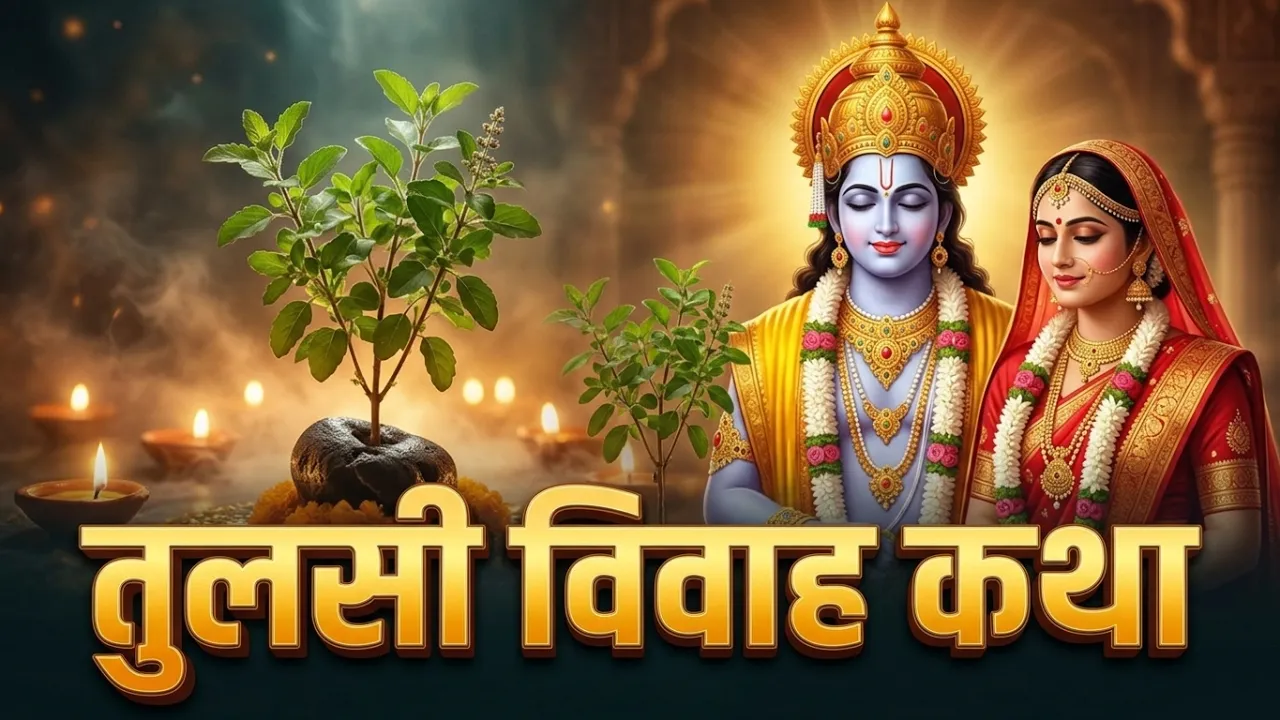
Some time later, a remarkably beautiful and divine plant sprouted from the ashes at the spot where Vrinda had sacrificed herself. Lord Vishnu arrived there and, with immense love and reverence, named that plant— ‘Tulsi’.
Honoring his devotee, Lord Vishnu made a solemn promise— “O Vrinda! Because of your purity and devotion, you are even dearer to me than Goddess Lakshmi. To uphold your words, one of my forms will forever remain as this black stone, known as ‘Shaligram’. Your form as Tulsi will be worshipped for ages to come. My worship without you, and your worship without me, will always be considered incomplete. From this day forward, I will never accept any offering without a Tulsi leaf.”
Along with this, Lord Vishnu granted another boon: every year, when he awakens from his four-month cosmic sleep (Yog Nidra) on the auspicious day of Dev Uthani Ekadashi (the eleventh day of the bright fortnight in the month of Kartik), his Shaligram form will be ceremoniously married to Goddess Tulsi with great grandeur.
Meanwhile, it was due to Vrinda’s second curse that when Lord Vishnu incarnated as Lord Rama in the Treta Yuga, he had to endure the pain of separation from Goddess Sita.
Religious Significance of Tulsi Vivah
This is why, even today, ‘Tulsi Vivah’ is celebrated with immense devotion and joy across India every year between Dev Uthani Ekadashi and Kartik Purnima. It is believed that anyone who performs the marriage of Goddess Tulsi and Lord Shaligram with a pure heart earns the great spiritual merit equivalent to Kanyadaan (giving away a daughter in marriage). It brings peace, happiness, and prosperity to the household, and removes all obstacles from one’s married life.
Hail Goddess Tulsi! Hail Lord Shri Hari Vishnu!