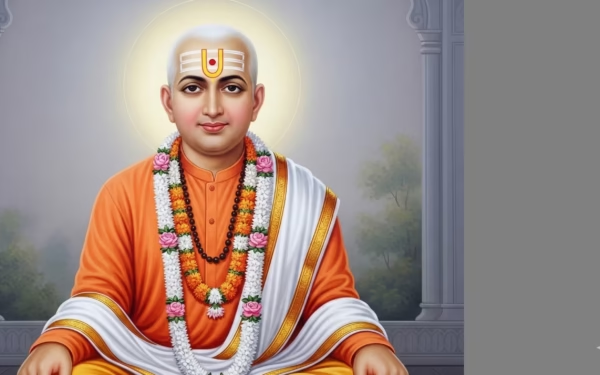
India’s spiritual history is rich with figures who have guided the masses toward enlightenment, but few have managed to bridge the gap between divine devotion and active national duty quite like Rashtrasant Tukdoji Maharaj. Operating during a critical juncture in Indian history—a period marred by British colonial rule, deep-rooted social inequalities, and rampant rural poverty—he realized that spiritual salvation could not exist in a vacuum. He was not an ascetic who retreated to the Himalayas to meditate in isolation; rather, he was a dynamic spiritual leader and a fierce social reformer who walked among the common people, turning the dust of rural India into his sacred ash.
Recognizing his profound impact on the nation’s cultural and social fabric, Dr. Rajendra Prasad, the first President of India, bestowed upon him the revered title “Rashtrasant” (Saint of the Nation). This was not merely an honorary title; it was a testament to a man who seamlessly fused nationalist fervor with profound mysticism. Through his powerful verses, tireless travel, and untiring activism, Tukdoji Maharaj redefined spirituality as the selfless service of humanity, declaring that the true worship of God lay in the upliftment of the nation and its poorest citizens.
Early Life: The Boy from Yavali
Rashtrasant Tukdoji Maharaj was born on April 30, 1909, in the small, unassuming village of Yavali in the Amravati district of Maharashtra’s Vidarbha region. He was named Manikrao Bandoji Thakur by his parents, Bandoji and Manjula, who belonged to a humble, hardworking family of tailors. The agrarian landscape of Vidarbha, with its inherent struggles and simplicity, provided the initial canvas for his worldly observations.
From a very young age, Manikrao showed little interest in formal education or the traditional family trade. While other children played or learned a craft, he possessed an innate, restless inclination toward spirituality, introspection, and asceticism. He would often disappear for hours to sit in deep meditation in the nearby forests, seeking the quiet company of nature and wandering sadhus. His unconventional behavior often worried his parents, who could not comprehend his mystical visions or his complete detachment from material desires. This intense, unquenchable spiritual thirst eventually led him away from a conventional household life and toward a path that would alter the destiny of millions of marginalized Indians.
Spiritual Awakening and the Grace of His Guru
The turning point in young Manikrao’s life occurred when he met Aadkoji Maharaj, a highly revered mystic residing in Warkhed. Aadkoji Maharaj, known for his piercing spiritual insight, instantly recognized the immense, untapped potential within the wandering boy and accepted him as his disciple. Under this tutelage, Manikrao learned the intricate balance of Bhakti (devotion), Yoga (discipline), and Karma (action).
It was Aadkoji Maharaj who affectionately began calling him “Tukdya.” In the local rural tradition, “Tukdya” refers to a humble beggar asking for a piece of bread—a “tukda.” Philosophically, it symbolizes the ultimate surrender of the ego and the realization that every human being is merely a beggar standing at the door of the divine. Manikrao embraced this name wholeheartedly, adopting it as his pen name and his very identity. From that moment on, he became Tukdoji, the humble servant of God and humanity. Under his Guru’s guidance, Tukdoji Maharaj came to a profound realization: true devotion was not merely chanting mantras in temples, but actively working to eradicate the hunger, ignorance, and suffering of his fellow human beings.
The Khanjiri and the Voice of Awakening
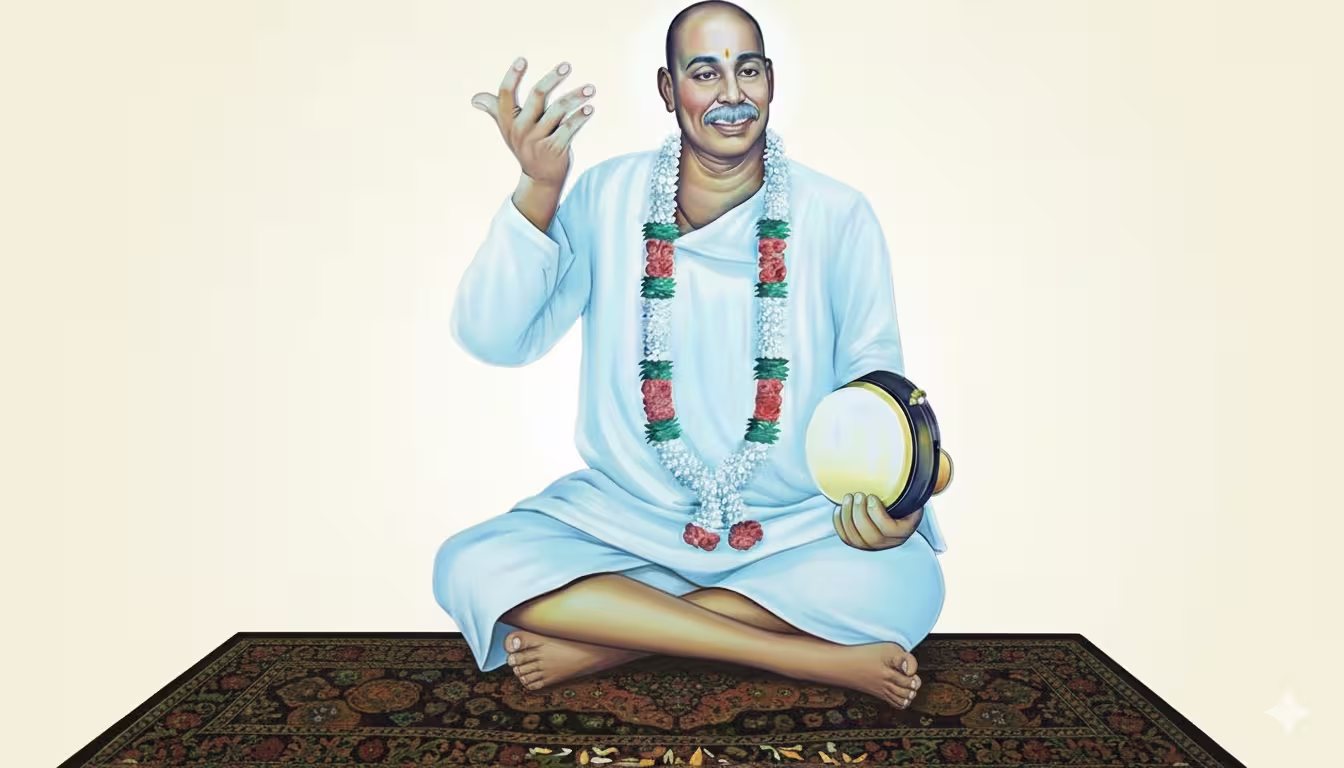
Tukdoji Maharaj was famously known for his unique, magnetic, and highly unorthodox style of delivering spiritual discourses (kirtans). Unlike classical musicians or orthodox priests who relied on complex instruments or rigid scriptures, his constant companion was the khanjiri, a simple, traditional tambourine-like percussion instrument. When Tukdoji Maharaj stood on a stage, playing his khanjiri with rhythmic fervor and singing his self-composed bhajans, the effect was electric. He would hold thousands of villagers spellbound, swaying the masses with a tempo that mirrored the heartbeat of rural India.
His bhajans were radically different from traditional devotional songs. While they praised the divine, they were heavily laced with urgent messages of social awakening. He sang vehemently against the rigid caste system, the cruelty of untouchability, blind faith, dowry, and animal sacrifice. Composing in a language that was simple, rustic, and deeply relatable—often blending Marathi and Hindi—his poetry bypassed intellectual barriers and struck directly at the hearts of the rural masses. His khanjiri became an instrument of mass communication long before the era of mass media, echoing the urgent need for a progressive, educated, and egalitarian society. He famously proclaimed that ringing the bells of social change was far more sacred than ringing temple bells.
A Saint in the Freedom Struggle and Beyond
What truly sets Tukdoji Maharaj apart in the pantheon of Indian saints is his active, fearless participation in the Indian freedom struggle and his lifelong commitment to national security. During the pivotal 1942 Quit India Movement, when Mahatma Gandhi gave the final call to “Do or Die,” Tukdoji Maharaj used his immense spiritual influence to mobilize the youth of Vidarbha. The Chimur and Ashti uprisings, which became legendary episodes of resistance in Maharashtra, were heavily inspired by his fiery discourses.
He traveled extensively from village to village, using his kirtans to ignite nationalist fervor and anti-imperialist sentiment. His songs became the anthems of resistance against British colonial rule, effectively transforming spiritual gatherings into political rallies. His influence was so powerful and widespread that the British authorities recognized him as a significant threat to their regime. Consequently, he was arrested in 1942 and incarcerated in the central jails of Nagpur and Raipur. Even behind bars, his spirit remained unbroken; he organized his fellow political prisoners, leading prayers and continuing to inspire them with his patriotic poetry.
His dedication to the nation did not end with independence in 1947. He expanded his vision to global peace and national defense. In 1955, he represented India at the World Parliament of Religions in Japan, where his message of universal brotherhood and global peace resonated deeply with an international audience. Furthermore, during the Indo-China War of 1962 and the Indo-Pak War of 1965, he traveled to the rugged borders to sing his khanjiri bhajans, boosting the morale of the Indian Armed Forces. He was a saint who understood that defending the motherland was a sacred duty.
Gramgeeta: The Epic of Village Upliftment
Tukdoji Maharaj’s most monumental and enduring contribution to Indian literature, sociology, and philosophy is the Gramgeeta (The Song of the Village). Written in lucid Marathi, this epic poem is considered a masterclass in rural development, sustainable living, and self-reliance. It serves as a modern scripture for grassroots empowerment.
While the traditional Bhagavad Gita teaches individual spiritual duty, the Gramgeeta acts as a practical, comprehensive manual for community living and collective salvation. In it, Tukdoji Maharaj argued that God (“Daridra Narayan”) does not reside in stone idols locked inside grand temples, but in the heart of the village, in the fertile soil, and in the sweat of the honest laborer. The text meticulously outlines the importance of:
- Cleanliness and Hygiene: He advocated for impeccably clean villages, proper sanitation, and personal hygiene decades before modern government sanitation campaigns like Swachh Bharat were conceived.
- Shramdaan (Voluntary Labor): He passionately encouraged villagers to take ownership of their infrastructure, urging them to build their own roads, dig their own wells, and construct their own schools without passively waiting for government intervention.
- Eradication of Social Evils: The text firmly rejects caste barriers, untouchability, dowry, and superstition, advocating for scientific temper and absolute equality among all human beings, including a strong emphasis on women’s education.
- Self-Reliance and Local Economy: Promoting Grama-nirman (village building), he envisioned villages as self-sufficient republics, encouraging local industries, cooperative agriculture, and the use of indigenous goods to make villages economically independent.
The Gramgeeta remains a highly revered, living text. It is not just read but actively studied and recited in thousands of villages across Maharashtra as a blueprint for ideal community living.
Gurukunj Ashram and Grassroots Development
To put his visionary ideas into concrete practice, Tukdoji Maharaj established the Sri Gurukunj Ashram in 1935 at Mozari, situated on the Amravati-Nagpur highway. The ashram was never meant to be a quiet retreat for reclusive monks; instead, it was designed as a bustling, dynamic hub of social transformation and practical learning.
Gurukunj Ashram became a rigorous training ground for Gram-sevaks (village social workers). It actively promoted inter-caste dining to systematically break down centuries-old social barriers. The ashram established schools for basic and vocational education, created agricultural cooperatives, promoted Khadi (homespun cloth), and set up Ayurvedic dispensaries to provide affordable healthcare to the rural poor. Central to the ashram’s daily life was the Sarva Dharma Prarthana (All-Faith Prayer), which reinforced the belief in universal brotherhood and the fundamental unity of all religions. The ashram stood—and continues to stand—as a living, breathing prototype of the utopian village Tukdoji Maharaj envisioned in the Gramgeeta: a community thriving on equality, hard work, and mutual respect.
An Enduring Legacy
Rashtrasant Tukdoji Maharaj breathed his last on October 11, 1968. His mortal remains were laid to rest at the Gurukunj Ashram in Mozari, where his Samadhi stands today not merely as a monument, but as a beacon of peace, action, and inspiration.
The physical departure of the saint did not diminish his immense impact. Today, the Gurukunj Ashram relentlessly continues his mission, spearheading rural upliftment, organizing massive disaster relief efforts, and running extensive educational and medical programs. Every year, during his Punyatithi (death anniversary), millions of devoted followers from across the country gather at Mozari to pay their respects. The massive gathering is managed entirely by disciplined volunteers through Shramdaan, featuring enormous community kitchens that feed all regardless of caste or creed. The atmosphere constantly reverberates with the rhythmic, soul-stirring beats of the khanjiri and the chanting of his revolutionary bhajans.
Recognizing his unparalleled contribution to the region’s intellectual and social awakening, the Government of Maharashtra renamed the Nagpur University to ‘Rashtrasant Tukadoji Maharaj Nagpur University’ in 2005. This ensured that his name remains permanently synonymous with education, enlightenment, and progress. Through the enduring, pragmatic wisdom of the Gramgeeta and the active, continuing traditions of his followers, Rashtrasant Tukdoji Maharaj’s vision of an awakened, self-reliant, spiritually grounded, and united India remains as vital, necessary, and inspiring today as it was during his extraordinary lifetime.