Even in modern society, ‘menstruation’ or ‘periods’ remains a hushed word, heavily wrapped in stigma and silence. Across many households today, menstruating women are still kept away from kitchens, and their entry into places of worship is strictly prohibited. But did you know that India hosts a centuries-old festival that not only celebrates a Goddess going through her menstrual cycle but also worships the very water flowing during this time as supremely sacred?
The ‘Ambubachi Mela’, celebrated at the revered Maa Kamakhya Temple atop the Nilachal Hills in Guwahati, Assam, is not just a religious gathering. It is a grand celebration of womanhood, the cycles of nature, and fertility—one that directly challenges and dismantles every orthodox taboo associated with menstruation.
Table of Contents
When the Goddess Rests for Three Days
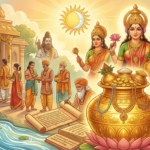
Held every year in the month of June (the month of Aashaadh according to the Assamese calendar), the Ambubachi Mela marks a profoundly unique cosmic event. According to Puranic and Tantric traditions, this is the time when Mother Earth, personified as Goddess Kamakhya, undergoes her annual menstrual cycle.
For three days, the main doors of the temple remain completely closed to all devotees. This specific period is known as ‘Pravritti’. During these three days, no temple bells are rung, and no daily rituals or pujas are performed. The underlying belief is simple yet beautiful: just as a woman requires rest during her periods, the Goddess too rests for these three days.
This reverence extends beyond the temple walls. Honoring the menstruating Mother Earth, local farmers and agricultural workers completely stop digging the ground, sowing seeds, or ploughing their fields. It is an extraordinary example of respect for nature, reminding us that the Earth is our ultimate mother.
A Revered Shaktipeeth Without an Idol
The most striking feature of the Kamakhya Temple is that there is no idol or image of the Goddess inside the sanctum sanctorum (Garbhagriha). Instead, devotees worship a naturally formed yoni-shaped (female reproductive organ) fissure in a rock, through which an underground natural spring flows continuously.
Hindu mythology tells the tale of Lord Shiva performing the Tandava (the dance of destruction) while carrying the lifeless body of his beloved wife, Sati. To calm him and save the universe, Lord Vishnu used his Sudarshan Chakra to sever Sati’s body. It is believed that Sati’s womb and ‘yoni’ fell on the Nilachal Hill. Consequently, this site emerged as one of the 51 Shaktipeeths, known today as the most powerful center for Tantric worship.
‘Rakta Bastra’: The Sacred Prasad Millions Yearn For
After the Goddess’s three-day resting period, the temple doors are finally reopened to the public on the fourth day—an event known as ‘Nivritti’. Millions of devotees, including mysterious Aghoris, Tantriks, Sadhus, and ordinary pilgrims from across the globe, throng the temple for a glimpse of the Goddess.
Before the doors are closed on the first day, the temple priests place a piece of white cloth inside the sanctum over the stone fissure. When the doors are reopened on the fourth day, the cloth is found soaked in red. This cloth is revered as the ‘Rakta Bastra’ (Blood Cloth).
Unlike orthodox traditions that deem menstrual blood impure, this red-stained cloth is considered the ultimate, most sacred blessing (Prasad). Devotees wait in queues for days just to receive a tiny thread of this cloth, believing it brings immense prosperity, fertility, and good fortune.
A Profound Lesson for Modern Society
The Ambubachi Mela beautifully exposes a glaring paradox in Indian society: on one hand, society marginalizes menstruating women by calling them ‘impure’, while on the other, millions of men and women bow their heads in reverence before a menstruating Goddess.
This grand festival serves as a powerful reminder that ancient Indian culture never viewed a woman’s body or her natural biological changes through the lens of shame or impurity. Menstruation is the foundation of human life; without this natural cycle, the existence of humanity is simply impossible.
Through the Ambubachi Mela, Maa Kamakhya poses a striking question to modern India: “How can a natural cycle—without which creation is impossible, and for which you worship a Goddess—be a subject of untouchability and shame for an ordinary woman?”
The Ambubachi Mela is more than just the ‘Mahakumbh of the East’; it is a vibrant celebration of the power of the divine feminine—a truth that every society must embrace without hesitation.